The enticing aroma, rich sweetness, creamy texture, and golden color of Dục Mỹ soy sauce from Phú Thọ province create an unforgettable taste, leaving those who have tried it longing for the distinctive flavor of this local sauce.
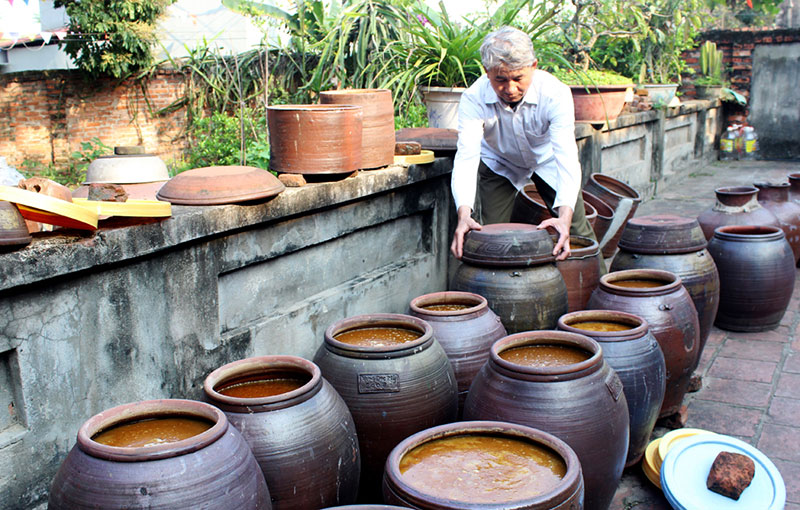
Located less than ten kilometers east of the center of Việt Trì city, Dục Mỹ village (Cao Xá commune, Lâm Thao district, Phú Thọ province) is renowned for its traditional soy sauce-making craft. For generations, the secrets of making delicious soy sauce have been preserved and passed down from one generation to another.
According to the elderly in the village, the name Dục Mỹ is associated with the legend of a beautiful, virtuous girl who had a good reputation in the ancient land of Văn Lang. The exact origin of the soy sauce-making profession is uncertain, but it is known that when the girl from Dục Mỹ got married and moved elsewhere, she managed to maintain the soy sauce-making secrets and passed them on to future generations.
The key ingredients for making Dục Mỹ soy sauce are glutinous rice, soybeans, salt, and water. While the process of making soy sauce here doesn’t differ much from the traditional method—mold cultivation, fermentation, and maturation—the special flavor of this sauce is believed to be attributed to the use of sweet water sourced from hundreds of meters deep under the thick layer of honeycomb rocks.
The main component of soy sauce mold is glutinous rice cooked until it’s tender, then stored in a sheltered, wind-protected area to undergo natural mold cultivation. Mrs. Đỗ Thị Nghì, the owner of the well-known Thanh Nghì soy sauce production facility, emphasizes the importance of taking extra precautions during adverse weather conditions. If the soy sauce is exposed to rain, the entire batch must be discarded. Notably, Dục Mỹ soy sauce is specifically made in June and July. To ensure a year-round supply, soy sauce producers store their mold in large bamboo huts and follow special preservation protocols.
In 2006, Dục Mỹ village was officially recognized by the provincial People’s Committee of Phú Thọ as a traditional soy sauce craft village. This recognition has motivated soy sauce producers even more.
Dục Mỹ soy sauce started to appear in provincial fairs in Phú Thọ and entered the markets of neighboring provinces, gaining an advantage over other soy sauces. With just 20,000 VND, customers can buy a liter of delicious soy sauce. Mrs. Hoàng Thị Quyên, while purchasing soy sauce at Thanh Nghì soy sauce production facility, mentioned that whenever she visits her hometown, she often buys soy sauce for her entire family. “The soy sauce here is delicious, thick, and has a very special flavor,” she added.
The quality of Dục Mỹ soy sauce is increasingly emphasized, establishing trust among customers. Therefore, it’s not surprising that many vehicles stop at soy sauce shops to make bulk purchases. Mrs. Đỗ Thanh Nghì happily mentioned, “The soy sauce is usually sold out within a day or two. Recently, a group of cars came from afar, and they bought 40 liters at once.”
Previously, soy sauce making was considered a secondary occupation alongside agricultural activities. However, it has now become the main source of income for many households in the area. Along the winding shaded road, there are many soy sauce shops, such as Quân Huấn soy sauce, Hòa Lai soy sauce, Kim Luyến soy sauce, etc. Thanks to the traditional soy sauce product, Dục Mỹ is changing every day, with many well-equipped houses appearing.
Mrs. Đỗ Minh Phượng, one of the owners of a large-scale soy sauce production facility, shared her thoughts, “The soy sauce-making craft was passed down from my ancestors. Initially, we only made soy sauce for personal consumption, but later on, it became the main profession, providing a livelihood for the whole family.”
Food safety for Dục Mỹ soy sauce is a matter of great concern for many producers. While all the soy sauce-making processes here are done manually, food safety and hygiene are prioritized. The utensils used for making soy sauce are thoroughly cleaned and dried before use. The mold cultivation and fermentation processes are carried out meticulously and carefully.
Mr. Phạm Văn Thành, the head of the craft village, stated, “Out of nearly 400 households here, about two-thirds are engaged in soy sauce production and business. We regularly conduct inspections of food safety and hygiene. Any household found violating the regulations is given a warning, and if there is a repeat offense, they will be forced to stop selling.”
In addition to inspections by the local authorities of Cao Xá commune, Lâm Thao district, regular training sessions on food safety and hygiene for soy sauce production are organized. Therefore, the quality of Dục Mỹ soy sauce is continually affirmed, deserving the title of a recognized craft village since 2006. It is hoped that in the future, Dục Mỹ soy sauce will become a prominent brand, reaching markets nationwide.
 1168 Hung Vuong Street, Thanh Mieu Ward, Phu Tho Province, Vietnam
  +84889.30.19.19
  contact@visitphutho.vn


