Chí Tiên Commune, Thanh Ba District, Phu Tho Province
5 (1 review) Cultural Heritage
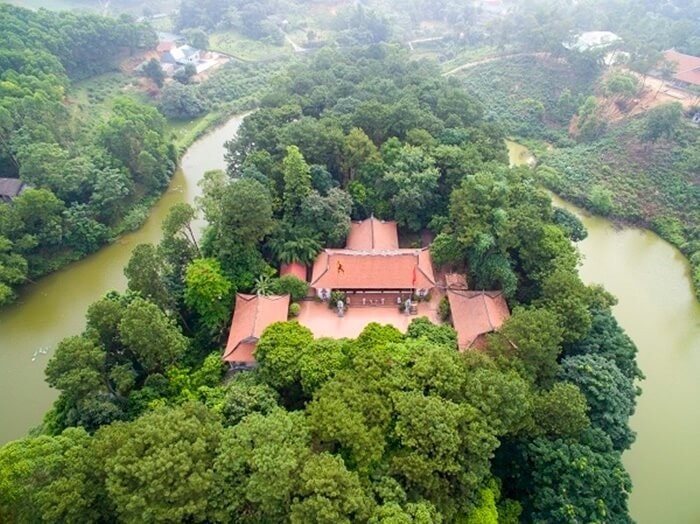
Du Yen Temple is located in Chí Tiên Commune, Thanh Ba District, Phu Tho Province, on a picturesque hill with lush greenery; at its feet lies a pristine lake, and it faces the Thao River, providing a peaceful setting throughout the year. This lengthy strip of land is part of the provincial highway, a crucial transportation artery for Thanh Ba District.
In 1993, Du Yen Temple was officially recognized by the state as a national-level historical relic. In 2003, the temple underwent restoration, including the main ritual hall with five sections and the rear hall with three sections, as it stands today. The temple houses various precious artifacts such as the altar, ceremonial palanquin, ritual utensils, precious bowls, bronze tablets, and inscriptions in Nôm script on both sides. The statues within the temple are crafted from wood. Besides the imperial edicts from the Đinh, Lý, Trần, and Lê dynasties, this is the only temple that has preserved a genealogy documenting the two-thousand-year development of a lineage in Thanh Ba.
According to the Ngọc Phả legend, in the Thao Giang region, at the present site of Bổng Châu, which is now Tiên Châu village in Chí Tiên Commune, Thanh Ba District, Phu Tho Province, there was a Nguyen family known for their kindness and diligence in business, earning them great respect in the region. Due to heavenly blessings, they bore a daughter named Hạnh Nương. Hạnh Nương, nurtured and educated attentively by her parents since childhood, was an extraordinarily intelligent, beautiful, gentle, and scholarly girl who had a passion for martial arts. Despite numerous suitors in the village, she declined all proposals to maintain her purity. Hạnh Nương raised the flag of justice, practiced archery and swordsmanship day and night, gaining a reputation as the Goddess of Warfare. In the 40th year after the Common Era, when the Eastern Han invaders, led by the ruthless warlord Tô Định, brazenly oppressed the nation, Hạnh Nương joined the resistance under the leadership of the Trưng Sisters, who recognized her intelligence, beauty, literary talent, and martial prowess. The Trưng Sisters bestowed upon her the title of Princess Ngọc Loan and the position of Commander-in-Chief of the Vanguard after successfully defeating the Tô Định forces. Following the victory, the heroine Nguyễn Thị Hạnh returned to her homeland and hosted a celebratory feast for the villagers, rewarding their contributions. The festive event took place on a small hill shaped like a white tiger lying down to drink water by the Thao River. Subsequently, the villagers erected a temple known as Hành Cung Du Yến (now known as Du Yen Temple in Chí Tiên Commune) at this location. Since then, every year on the full moon of the first lunar month, the villagers hold a grand festival to commemorate Hạnh Nương’s contributions, praying for favorable weather and prosperity for each household.
The Du Yen Temple festival is one of the most prominent cultural events in Thanh Ba, attracting tens of thousands of tourists both domestically and internationally each year. The festival begins with ritual ceremonies and is followed by a lively fair. Offerings to the Mother Goddess mainly include vegetarian cakes and fruits, divided into six sections, with each section having two trays carried by two young men and placed on the altar for the ancestors. During the rituals, there are interspersed performances of fairy dances and ancestral worship dances.
Legend has it that when the Mother Goddess was born, celestial fairies descended to earth, dancing and singing like a festival, hence the requirement to have a fairy dance team consisting of four girls under 16 years old, unmarried, performing beautiful fairy dances to serve the ritual. This ritual has been revived and slightly modified to fit the festival’s space. Following this, the procession begins, with the flag team at the forefront, followed by the drum team, bat figurines team, lion dance, fairy dance, and finally, the palanquin procession.
 1168 Hung Vuong Street, Thanh Mieu Ward, Phu Tho Province, Vietnam
 +84889.30.19.19
 contact@visitphutho.vn


