Mr. Hoàng Quỹ, originally from Liên Ninh, Thường Tín, Hà Đông, moved to Hanoi at a young age to pursue a career in making cakes and candies. Before 1930, he brought his family to settle in Phú Thọ Town, where he opened a store named Quảng Hưng Long, specializing in selling candied fruits and sweets.
After a period of working, he considered settling in Đá Chông Sơn Tây but due to the resistance against the French, faced economic difficulties. Mr. Hoàng Quỹ then took his family to Vũ Ẻn, establishing another Quảng Hưng Long store there. When peace was restored, he returned to Phú Thọ Town. His children, Mr. Hoàng Kỳ (son), Mrs. Hoàng Thị Huệ (daughter), and Mr. Tạ Quyết (son-in-law), worked together in the cooperative Tiến Bộ, specialized in producing candied fruits and sweets. Mr. Hoàng Kỳ managed the technical aspect of the cooperative, which later became the Phú Thọ Town Confectionery Company until his retirement. When private production was allowed by the government, Mr. Hoàng Kỳ established a private production facility named Hoàng Vần. Mrs. Huệ and Mr. Quyết also opened their production facility named Tạ Quyết. Later, the children and grandchildren of Mr. Hoàng Quỹ expanded the production with various names such as Thu Thủy, Tuấn Anh, Luận Sang, Hoàng Dung, Hoàng Cải, and more.
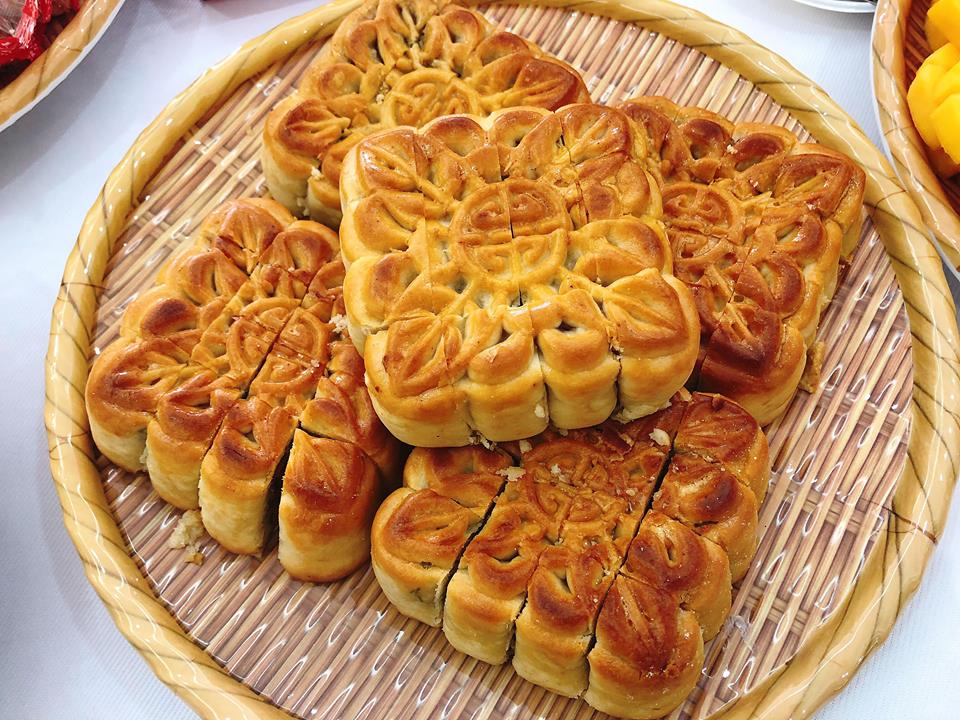
Among the diverse range of products in the confectionery production facilities of the ancestors and their descendants today, the most famous are the Mid-Autumn Festival cakes, closely associated with the traditional Mid-Autumn Festival (Trung thu) of the Vietnamese people.
Mid-Autumn Festival cakes come in two types: baked cakes and sticky rice cakes. Each cake, whether baked or sticky, consists of an outer layer called the crust and an inner layer called the filling.
To make baked cakes, sugar water is boiled and left to cool, then mixed with enough elastic flour to make the crust. The filling includes glutinous rice flour, candied pumpkin, pumpkin seeds, boiled pork fat seasoned with sugar, candied lotus seeds, grilled ribs, sweet potato chunks, sesame seeds, and roasted peanuts. The mixture of glutinous rice flour, sugar water, and finely chopped ingredients is turned into the filling. Using the crust, the filling is enveloped, the mold is closed, and the cakes are arranged on a tray brushed with chicken egg before being placed in the oven, adjusting the temperature to evenly brown the two sides of the cake and cook the filling inside.
The sticky crust is made from glutinous rice, roasted until it becomes crunchy, ground into powder, then mixed with cooled sugar water to create the crust. The filling includes glutinous rice flour, boiled pork fat seasoned with sugar, roasted sesame seeds, pumpkin seeds, grilled ribs, sweet potato chunks, candied pumpkin, candied lotus seeds, and a fragrance made from pomelo blossom essence. The mixture of crust and filling is enclosed using the crust mold to create sticky rice cakes.
Today, the fillings of both sticky and baked cakes have been greatly improved with ingredients such as green beans, red beans, taro, salted eggs, and young sticky rice.
The process of making cakes is something outsiders might know, but creating a brand is the family’s trade secret. Careful selection of ingredients, artistic refinement in processing, and the experience and creativity in this process are things outsiders cannot know. The standards of flour, sugar, the right ratio of sugar to flour, how to choose pork fat, how to boil it, how long to marinate it with sugar, how to extract the pomelo blossom essence, and the proportions put into the cake – these are the secrets behind the Hoàng Vần and Tạ Quyết Mid-Autumn Festival cakes of Phú Thọ Town.
For those far away, they simply refer to them as Phú Thọ Town Mid-Autumn Festival cakes. Every Mid-Autumn Festival season, these cakes are distributed far and wide, reaching tens of tons every year.
 1168 Hung Vuong Street, Thanh Mieu Ward, Phu Tho Province, Vietnam
  +84889.30.19.19
  contact@visitphutho.vn


