Thanh Son district is a mountainous region located in the southwest of Phu Tho province, with many ethnic communities living together, each with its own unique cultural features, customs, and distinctive cuisines. If the Thai ethnic group has Can wine, the Mong ethnic group has Corn and Rice wine, then for the Dao ethnic group in Thanh Son (Phu Tho) and some other regions across the country, they have Hoang wine (also called Tiu Bau). This traditional liquor of the Dao people is famous for its fragrant and sweet taste of glutinous rice.
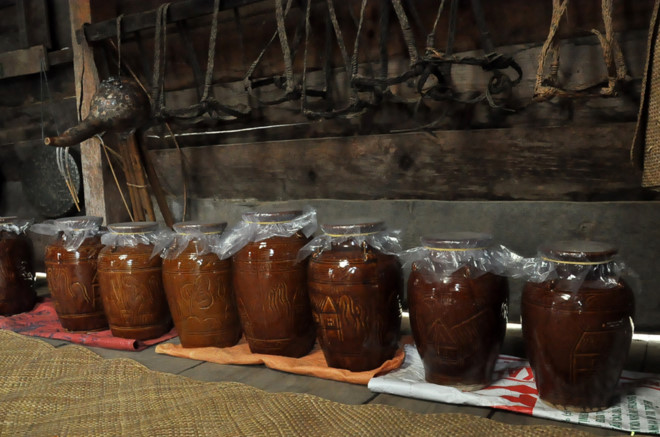
The origin of Hoang wine is not well-known, but this unique beverage has been an integral part of the Dao people’s daily life for a long time. If tourists have the opportunity to visit Chua area in Yen Son commune, Thanh Son district, they will witness the Dao people here still practicing the tradition of making Hoang wine. This drink is familiar in traditional festivals, weddings, the beginning of the year, especially during Tet. On every Tet occasion, Dao families will make Hoang wine and sour meat to treat their esteemed guests, wishing each other a peaceful and happy new year.
To create a delicious liquor with a distinctive flavor, it takes a considerable amount of time and meticulousness in each stage, from preparing ingredients to fermenting and aging the wine. The main ingredient for making Hoang wine is white glutinous rice without mixing it with ordinary rice. The glutinous rice is soaked for 7 to 8 hours and then steamed. After the sticky rice is cooked, it is spread evenly on large bamboo trays. The next step involves preparing the leaf yeast to mix with the sticky rice. The leaf yeast, made by the locals from various forest leaves, is crucial, and using commercially available yeast will affect the taste of the wine. The yeast for making Hoang wine is made from various precious medicinal herbs, offering a gentle and warm aroma. When the sticky rice is still warm, the leaf yeast is ground into a fine powder and evenly sprinkled on the prepared sticky rice. After sprinkling the yeast, the rice is evenly turned on the tray, banana leaves are used to cover the surface, and a warm blanket is placed over it to facilitate fermentation. After fermenting for 3 to 4 days and a pleasant aroma is present, the mixture is placed into a container with a tightly sealed mouth to prevent evaporation. Experienced winemakers emphasize that the lukewarm temperature of the sticky rice during fermentation is a crucial factor in determining the quality of the wine. If the sticky rice ferments while still too hot, the wine may turn sour, and if it cools down too much, it won’t turn into wine.
Once the sticky rice has fermented adequately, it is placed into containers for official fermentation, using a perforated bottle pressed down in the middle to allow the wine to flow into it, making it easier to extract. Normally, after about a week of fermentation, the wine will have a cloudy appearance similar to squeezed glutinous rice of the Kinh people. To produce good, strong wine, it needs to ferment for 2 to 3 months, resulting in Hoang wine with a shiny yellow color like honey, carrying the distinctive flavor of forest leaf yeast. According to Dao people’s beliefs, during festivals, Tet, or significant family events like housewarming parties or weddings, men will drink Hoang wine (also known as super wine, made from red rice), while women will drink Hoang wine to celebrate together. Combining Hoang wine with sour meat, sour bamboo shoots, colorful sticky rice, and other dishes creates a perfect harmony.
In the journey to explore the cuisine of the Land of Ancestors in Phu Tho, it would be a pity if tourists did not have the chance to taste the Hoang wine of the Dao people in Thanh Son. This beverage is becoming more widely known for its unforgettable sweet and fragrant taste, not as strong as regular white wine, making it very suitable for women. Nowadays, with various beverage options available, the distinctive Hoang wine of the Dao people in Thanh Son is still preserved and developed in the culinary culture of ethnic communities in the district.
 1168 Hung Vuong Street, Thanh Mieu Ward, Phu Tho Province, Vietnam
  +84889.30.19.19
  contact@visitphutho.vn


