When mentioning the mountainous district of Tan Son, travelers are likely to think of attractive tourist destinations such as Long Coc tea hills (Long Coc commune), often likened to the “Halong Bay of the Central Highlands” with its lush green tea hills creating a picturesque landscape, and Xuân Sơn National Park (Xuân Sơn commune) – a green tourism destination, possessing the pristine beauty of limestone mountains shrouded in white mist, and mysterious caves. Besides, when visiting Tan Son, tourists also have the opportunity to explore the cultural identity of ethnic minority communities and savor local specialties presented on leafy banquet tables, including wild boar, mountain chicken, stream fish, stone crab, stuffed duck with bamboo leaves, colorful sticky rice, boiled bamboo shoots, wild vegetables, sour papaya meat, or sautéed wild vegetables. However, it would be a missed opportunity if visitors don’t try the sour papaya meat, a rustic dish of the Muong people in Tan Son.
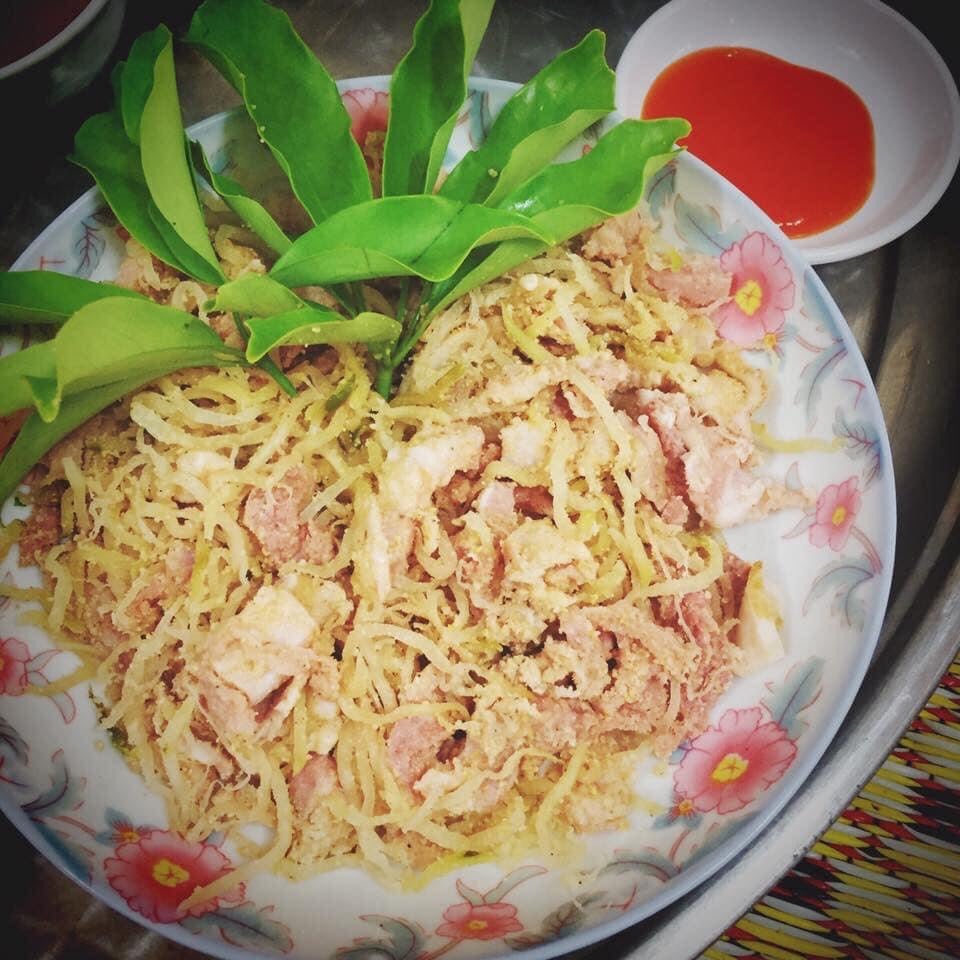
The cuisine of the Muong people is quite diverse, and among them, sour meat has been passed down through generations, becoming a specialty that many diners appreciate. Sour meat has long been known as a specialty of the Thanh Son region in Tan Son. Particularly, the Muong people in Tan Phu commune, Tan Son district, have been creative in making sour papaya meat, turning it into a unique and delicious dish. Sour papaya meat, also known as sour meat of papaya, is a favored dish used by the local people on festive occasions, Lunar New Year, or to entertain guests.
Ingredients include good-quality pork, green papaya, and roasted rice powder.
In Tan Phu commune, Tan Son district, Mrs. Hoang Thi Sau’s family has been making sour papaya meat for more than a decade. In the past, due to economic difficulties and a lack of storage facilities, whenever the family slaughtered a pig, they used to make sour meat to gradually consume. Later, with improved economic conditions, although they no longer needed to stockpile food as before, the family still maintains the tradition of making sour papaya meat to preserve and spread the traditional flavors of the ethnic community and the region. If in the past, the mixture of meat, roasted rice powder, and papaya strands, after marinating with spices, was compressed into dry bamboo cylinders lined with guava leaves and sealed at both ends with banana leaves or clean dong leaves. Nowadays, due to the demand for producing sour meat in large quantities, bamboo cylinders have been replaced by clean plastic jars with tight lids while still preserving the traditional flavor.
Sour meat can be made from buffalo or beef, but the most common is still pork. The ingredients for making sour papaya meat include pork belly or shoulder, ham, green papaya, and roasted rice powder. The meat needs to be fragrant and firm, often chosen from naturally raised free-range pigs, cut into small pieces. The meat is mixed evenly with white salt and roasted rice powder that has been golden-brown. Green papayas are selected when they are still unripe, cleaned of the peel, thoroughly washed to remove the latex, and the tail is shredded into strands. The papaya strands are kneaded with salt to soften the fibers, then put into a mold to remove excess water before mixing with pork and roasted rice powder. After seasoning with additional spices, the pork, papaya, and roasted rice powder are compacted in a jar and left for 3-5 days before being ready to eat. Sour papaya meat is served with leaves of sung, mơ, ổi, nhội, đinh lăng, and accompanied by chili sauce, creating a delicious flavor. When eating, you can feel the crunchy texture of papaya strands, the sweet and rich taste of pork, the aroma of roasted rice powder, all blending with the flavors of the mountains and forests, creating a unique and exotic dish.
If you ever set foot in the Tan Son mountains, you must try the sour papaya meat, as its special flavor is like a thread pulling travelers back, making them want to return with nostalgia.
 1168 Hung Vuong Street, Thanh Mieu Ward, Phu Tho Province, Vietnam
 +84889.30.19.19
 contact@visitphutho.vn


