The land of Phu Tho has long been known as the Central Highlands, not only famous for its terraced tea hills but also adorned with vast fields of lush and vibrant cassava hills. Cassava, once a staple crop helping people overcome times of hunger and scarcity, is now grown for its roots to feed livestock, and its leaves are utilized to nurture silkworms. Cassava is cultivated in various places in the province, with Cẩm Khê district being a notable area with endless hills of cassava, especially concentrated in Tiên Lương, Đồng Lương, and Điêu Lương communes.
Different from the petite and delicate silkworms fed with mulberry leaves, cassava silkworms are larger, approximately the size of an adult’s finger, with prominent spines running in rows from head to tail. Compared to silkworms fed with mulberry leaves, cassava silkworms are highly effective. Cassava leaves are readily available and inexpensive, and the silkworms are easy to raise, grow quickly, require minimal care, have a short harvesting time, and are less susceptible to diseases. All aspects of the silkworm can be utilized – lazy silkworms, which are silkworms with less silk or unable to spin a cocoon, can be separately collected and used as food. The remaining silkworms can be used to spin silk, and the female silkworms can be used as food for chickens, fish, and other animals. In a year, people can raise silkworms six times according to the cassava leaf season, which lasts from May to September or October each year.
Silkworms are a valuable source of nutrition, rich in protein, fat, vitamins, and minerals. Silkworms that have reached maturity are considered a high-nutrient food and are also used as a remedy for malnourished children, weak individuals, and postpartum women with low milk production. Silkworms are high in protein and fat, and their taste is rich and savory, similar to deer antler velvet. The fat content is also not negligible, making it suitable for cooking.
In the local culture, mature silkworms, especially those that have spun silk, are considered a nutritious food with medicinal properties. Silkworms can be used as a tonic for children with malnutrition, weak and exhausted individuals, and postpartum women with low milk production. Silkworms are rich in protein, fat, and various vitamins and minerals, making them a valuable food source.
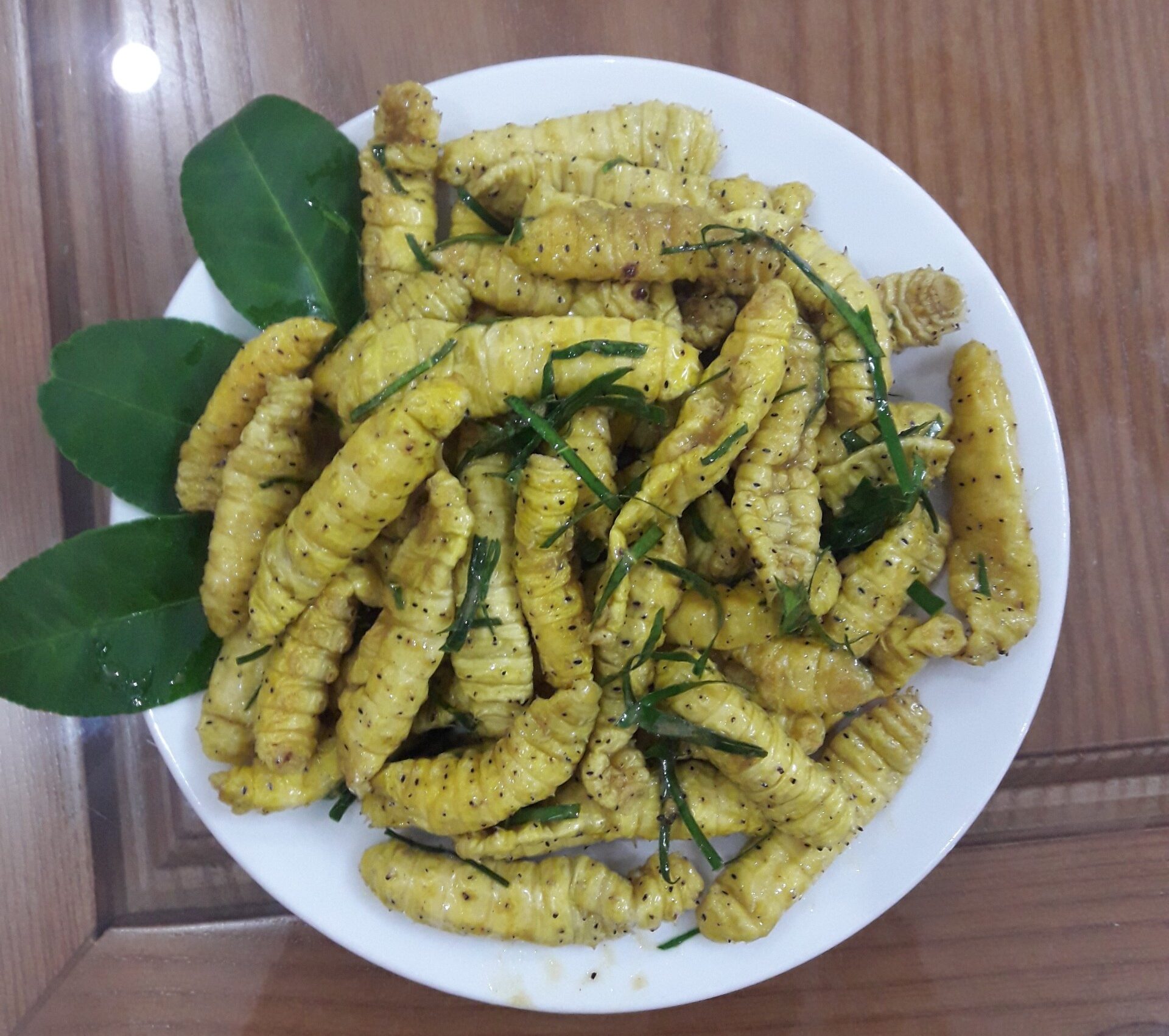
In the local area, silkworms are primarily processed into traditional dishes such as roasted silkworms with lime leaves, roasted silkworms with betel leaves, or deep-fried silkworms. For snacks or appetizers, boiled or fried silkworms are suitable. Boiled silkworms are selected from mature silkworms that no longer eat leaves. After cleaning and removing the silk, they are boiled with a little salt, and sometimes ginger and turmeric are added to make them yellow and fragrant. Boiled silkworms retain the original primitive taste of fresh silkworms, sweet, fragrant, and the silkworms remain juicy.
Deep-fried silkworms are also straightforward to make. After preparing by cleaning and removing the silk, cut off the head and legs, heat a pan, add cooking oil, and set the heat to medium. When the oil is hot, add the silkworms and fry them. Occasionally flip them to ensure an even color. After about 3 minutes, the silkworms will shrink and look crisp on the outside while remaining tender on the inside. When they turn golden, remove them from the pan and sprinkle lime leaves on top. This dish is best enjoyed while hot and makes an excellent appetizer for drinks. Silkworms are rich in flavor, retaining the chewy texture on the outside and a delightful tenderness on the inside. Those who can enjoy this dish may easily become addicted to its unique taste.
Roasted silkworms with lime leaves are also straightforward to prepare. After cleaning and preparing the silkworms by removing the head and legs, place them in a pan without oil and stir. When the silkworms release water, add a bit of soup powder and stir until the silkworms are cooked. Next, add a little fish sauce, then toss in finely chopped lime leaves or betel leaves. Stir well to allow the silkworms to absorb the aroma of the leaves evenly. Prepare a mixture of lime juice, garlic, and chili to dip the silkworms in. The dish is then ready to serve.
Enjoying cassava silkworms is not just about savoring a rustic delicacy but also experiencing the warmth of the people of Phu Tho, who are humble and close-knit. Each visit to the land of the ancestors becomes a culinary journey, leaving visitors reluctant to return.
 1168 Hung Vuong Street, Thanh Mieu Ward, Phu Tho Province, Vietnam
 +84889.30.19.19
 contact@visitphutho.vn


