When it comes to Muong people’s cuisine, diners often think of simple and rustic dishes with the flavors of mountains, forests, and rivers, such as stream fish, wild boar meat, sour bamboo shoots, and more. However, perhaps few have had the opportunity to savor a unique dish called “rau rừng đồ” (wild vegetable dish). In the highlands of Thanh Son, the Muong ethnic community creatively transforms ordinary wild vegetables into a distinctive and captivating dish, with a unique character that only the Muong people possess.
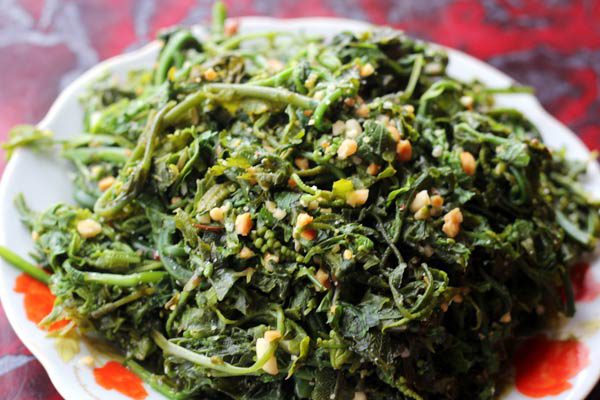
For generations, “rau rừng đồ” has been a familiar daily dish for the Muong people in Thanh Son. Due to their lifestyle and taste preferences, Muong people favor sour and bitter flavors and use the fermentation method to process vegetables. According to them, “rau đồ” differs from other vegetable dishes in that it preserves the distinctive flavors of each type of vegetable. “Rau rừng đồ” is crafted from various wild vegetables, typically harvested around homes, on mountain cliffs, and in gardens. Muong people use a variety of vegetables such as wild morning glory, bitter gourd leaves, amaranth, mugwort, betel leaves, pepper leaves, wild eggplant, and the essential elements: the stalks and leaves of male papaya trees and the white blossoms of male papaya trees. These components contribute to the bitterness in the dish.
In terms of preparation, after thorough cleaning, the vegetables are finely sliced, mixed evenly, and placed in a wooden tray. The tray is then steamed when the water is boiling. After 15-20 minutes, when the aroma of various vegetables, especially the betel leaves, fills the air, it indicates that the dish is ready. The steaming process ensures that the vegetables remain intact, vibrant in color, and rich in flavor.
To meet the standard, “rau rừng đồ” must maintain the green color of the vegetables, the white color of wild eggplants, male papaya blossoms, and the light brown color of wild banana blossoms. Additionally, it must preserve the characteristic bitter taste of mugwort and papaya leaves. Muong people consider “rau rừng đồ” a traditional dish, a symbol of their cultural heritage. Anyone, including those returning from farming, can harvest and prepare this dish. What makes it even more special is that among the wild vegetables brought back, some are used as medicinal herbs due to their bitter taste, natural heat, and effectiveness in preventing colds and boosting the body’s immunity.
Only with the resources from the mountains and forests have the Muong people of Thanh Son created such an enticing dish with a unique flavor. Mrs. Dinh Thi Van from Cau hamlet, Thach Khoan commune, shared that her family enjoys “rau đồ,” appreciating each vegetable for its distinct taste, making it a straightforward yet delightful dish.
However, to enhance the rich flavor of “rau rừng đồ,” it should be accompanied by a special fish sauce. To prepare this sauce, one must gather ingredients like fish intestines, turmeric, chili, tomatoes, spring onions, and salt. These ingredients are finely mixed to create the sauce. Mrs. Van adds that for the sauce to meet expectations, it is essential to choose high-quality fish intestines. The Muong people here often use the intestines of carp, clean them thoroughly, marinate them with familiar spices mentioned earlier, and use the fish’s own fat to sauté the intestines. The resulting fish sauce has a deep yellow color from fresh turmeric and a rich, fatty taste from the fish intestines.
This is when everyone comes together to enjoy the intense flavor of “rau rừng đồ” with the special fish sauce. The natural bitterness on the tip of the tongue blends with the rich, sweet, spicy, and fragrant taste of the fish sauce, leaving an unforgettable impression on diners. Although “rau rừng đồ” may seem simple, it encapsulates the hospitality of the Muong people. For the Muong people of Thanh Son, savoring “rau rừng đồ” with fish sauce is an opportunity for visitors to better understand the unique and diverse culinary culture of the Muong people across generations in this remote highland area that they cherish so dearly.
 1168 Hung Vuong Street, Thanh Mieu Ward, Phu Tho Province, Vietnam
  +84889.30.19.19
  contact@visitphutho.vn


