Hùng Lô Ancient Village, situated along the poetic Lô River, is approximately 5km from the center of Việt Trì city. The historical and cultural complex of Đình Hùng Lô (Hùng Lô Communal House) spans across an area of 5000m2. Originally the central hub of the ancient Khả Lãm site, later renamed from An Lão village to Hùng Lô commune.
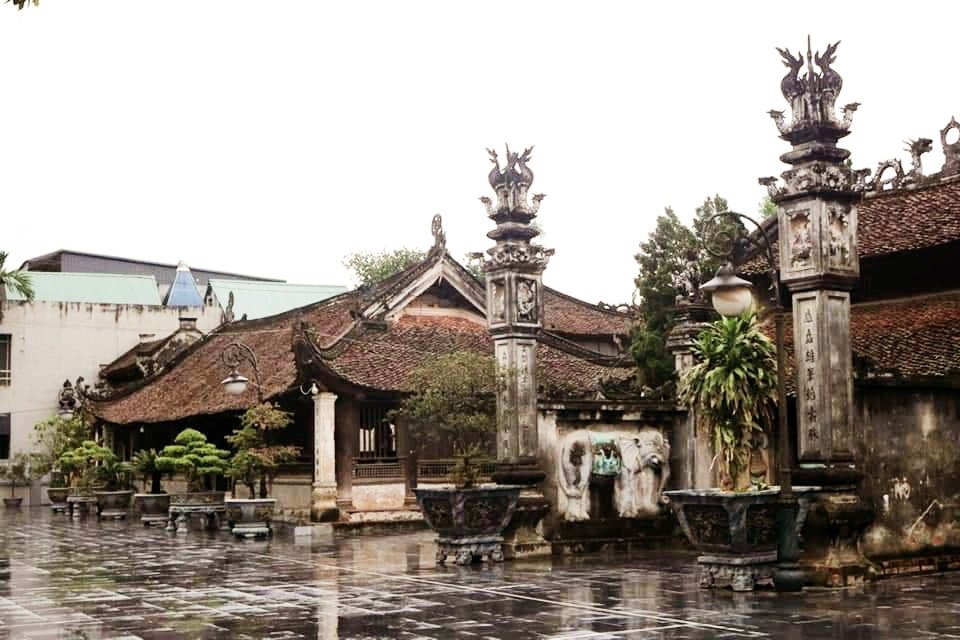
Hùng Lô Ancient Village, nestled along the charming Lô River, is about 5km away from the city center of Việt Trì. The historical and cultural complex of Đình Hùng Lô (Hùng Lô Communal House) was constructed on a 5000m2 plot of land. The central area of the ancient Khả Lãm site, later known as An Lão village, is now called Hùng Lô commune.
The temple (an ancient temple dedicated to the 18th Hung King) was built in an unknown era. According to the book “An Lão Thần Tích” and the legends passed down, “King Hùng and his princess often went on excursions and hunting trips, stopping to rest in Trang Khả Lãm (the ancient name of Hùng Lô). They found the land fertile, with lush vegetation and a naturally formed celestial pit, emitting a sacred aura from the earth. The king declared this place as a sacred land, encouraging people to cultivate it.” The Hùng Lô region gradually became populated, and after King Hùng, the people built a temple to commemorate their forefathers. The region prospered, and the temple became increasingly sacred.
According to another legend, during the uprising led by the Trưng Sisters against the northern invaders, the sisters passed through Hùng Lô. They knelt at the temple, offering incense and praying for victory. As a promise, they vowed to return to build a temple if they were successful. These tales are recorded on three gates in front of the temple.
The communal house was constructed in the late Lê Dynasty, during the reign of King Lê Hy Tông. The architectural elements of the communal house complex include the Main Hall, Phương Đình (a secondary structure within a temple complex), Bell Tower, Drum Tower, and the Ancestral Altar, all made from precious woods such as ironwood, eucalyptus, falcata, pine, and jackfruit. The roofs are tiled in a multi-ridge style. The intricate carvings, characteristic of the late Lê Dynasty, adorn wood, ceramics, and are mainly concentrated in the Main Hall.
The Main Hall is structured as a traditional three-bay, two-aisle house. The interior is equipped with altars for worship in all three bays. The worship items, made from ceramics, bronze, and wood, are meticulously engraved with delicate patterns, creating a harmonious and elegant appearance. Numerous precious artifacts have been preserved to this day.
The village also houses the Văn Chỉ Temple, dedicated to the Confucian scholar Khổng Tử. Here, during significant festivals, especially in the early days of spring, teachers and students gather to offer incense, seeking blessings for academic success.
The Buddhist Pagoda was established to meet the worship needs of local Buddhists and visitors. It is situated to the left of the communal house and was built a few decades ago.
The Agricultural Deity Platform, called Bệ Thần Nông, is a remnant of ancient worship. Villagers often organize annual ceremonies on the 25th day of the 5th and 10th lunar months, known as the Upper and Lower Cultivation Festivals, respectively. These events are held to pray for favorable weather and a bountiful harvest, ensuring the well-being of the community.
Presently, Hùng Lô commune preserves nearly 50 ancient houses ranging from 100 to 200 years old. Among them, five are classified as grand traditional houses, characterized by multiple rooms and large wooden columns. These ancient houses feature intricate carvings of mythical creatures such as dragons, unicorns, phoenixes, and the Four Gentlemanly Plants. Constructed primarily from wood, bamboo, and nipa palm, these structures are made from materials readily available in the natural environment, reflecting the life of the Vietnamese people. Residents continue to use and maintain these ancient houses, considering them not only as architectural treasures but also as spiritual elements preserved for future generations.
Village Ponds: The village has three ponds, with the main one located in front of the communal house. The communal house and ponds serve as the central gathering and developmental areas for residents.
Bamboo Dike: The bamboo dike serves as the administrative boundary of a hamlet, village, or neighborhood within a commune. Beyond the bamboo dike lies the cultivated fields of rice, corn, sweet potatoes, and cassava belonging to the residents.
Village Wells: The village boasts four communal wells named Đoàn Kết, Văn Chỉ, Thanh Rồng (also known as Dragon Fang Well), and Giẽ Well.
Hùng Lô Craft Village: Due to limited agricultural land, residents of Hùng Lô have historically been compelled to develop various small-scale crafts and industries to foster economic growth. Thus, Hùng Lô has been renowned for its diverse and prosperous craft villages, such as those specializing in making traditional Chung and Giầy cakes, soy products, rice vermicelli, and rice noodles. Locals jokingly refer to the village as the “Multitrade Village.” Traditional crafts like rice noodle making, with their ancient secrets passed down through generations, have allowed the people of Hùng Lô to create fine, durable, and non-sticky noodles, gaining popularity among locals and even in neighboring provinces. The Hùng Lô brand has become increasingly recognized in the market. The traditional craft of making Chung and Giầy cakes has a long-standing tradition. The delicious and beautiful cakes from Hùng Lô have the honor of being chosen every year to be presented to the Hung Kings during their commemorative ceremonies. The craft village producing Chung and Giầy cakes in Hùng Lô is becoming more and more popular and preferred by people from near and far.
Hùng Lô is also a village renowned for its traditional rice vermicelli-making techniques. Visitors to Hùng Lô can learn about the various steps involved in making vermicelli, taste the famous local products, and even participate in some of the vermicelli-making processes.
With its rich and diverse system of cultural heritage, the Hùng Lô Ancient Village showcases the wealth of its historical treasures. Particularly notable is the fact that elements such as ancient houses, communal houses, village ponds, and bamboo dikes continue to be diligently protected and preserved by the locals, serving as precious treasures for future generations.
A visit to the Hùng Lô communal house allows tourists not only to hear historical anecdotes for better understanding and pride in their traditions and roots but also to witness a Xoan singing performance. Since being introduced as part of the tourism service, to diversify cultural products, tourists scheduling visits to the Hùng Lô communal house are treated to a Xoan singing performance right at the entrance. The special feature lies in the melodies of this non-material cultural heritage expressed through the singing and dancing of the locals born and raised in the original Hùng Lô district, suddenly becoming strangely attractive and captivating.
Currently, the Hùng Lô commune has some families operating homestay services, providing visitors with an opportunity for sightseeing combined with rest and dining in the ancient houses of local families.
Through the combination of spiritual tourism and craft villages based on abundant cultural and historical resources, Hùng Lô Ancient Village promises to become an increasingly well-known destination for both local and international tourists. Presently, Phú Thọ province is re-planning the space for the cultural tourism site of Hùng Lô Communal House, transforming it into a spiritual tourism destination. The goal is to establish a tourism route connecting Đền Hùng (Hung Temple) and Đình Hùng Lô (Hùng Lô Communal House). It is hoped that, in the near future, community-based tourism products such as homestay services in the ancient village, bicycle tours, and more will contribute to the allure of this unique destination.
 1168 Hung Vuong Street, Thanh Mieu Ward, Phu Tho Province, Vietnam
  +84889.30.19.19
  contact@visitphutho.vn


