The Hung King’s Commemoration, known as the Hung Temple Festival, has its roots in the era of Hung Kings who laid the foundation for the nation. This significant festival takes place annually from the 6th to the 10th day of the third lunar month at the Historical Complex of Hung Temple.
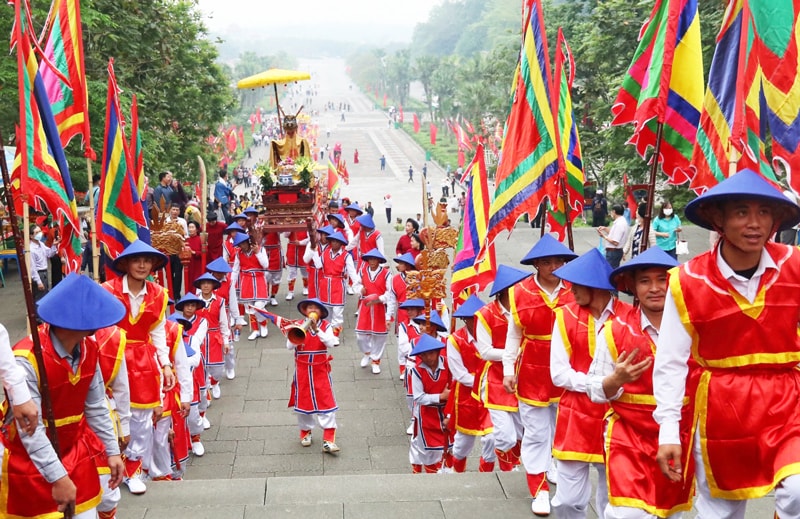
The event has evolved into the most prominent cultural and spiritual festival in Vietnam. Each year, during the commemoration and festival days, descendants from every corner of the country embark on pilgrimages to express sincere respect and gratitude to their ancestors for their role in establishing the nation. The Hung King’s Commemoration – Hung Temple Festival has become a spiritual driving force for the Vietnamese people.
Festival Structure:
Ceremonial Part: This segment unfolds with solemn rituals at the Upper Temple. Representatives from the Party, Government, and provinces participate in the flower-offering ceremony. Commencing on the evening of the 9th day, villages gather to carry palanquins, offering giày cakes, and chưng cakes, assembling under the Công Quán gate. Early the next morning, delegations line up neatly, following the procession, offering ritual items while moving towards the Upper Temple amidst the music of the bát âm drum and the precession dance team. Arriving at the entrance of the Upper Temple (Kính thiên lĩnh điện), the delegation stops, respectfully offering sacrifices to the Supreme altar. Provincial leaders, on behalf of the entire nation (in even-numbered years, it is the head of state or the leader of the Ministry of Culture, Sports and Tourism), respectfully read the Ancestor Worship Ceremony speech. The entire ceremony is broadcast on radio and television for people nationwide to follow. During the ceremonial activities, all temporary activities on the field are suspended to ensure the solemnity and seriousness of the Festival.
Festival Part: This is a lively and vibrant aspect in the area around Hung Mountain. The Hung Temple Festival now encompasses various rich cultural activities. In the festival area, numerous shops sell souvenirs, cultural products, and food services. There are cultural booths representing the 13 districts, cities, and provinces, with cultural performances and sports competitions. Traditional cultural activities and folk games are organized at the festival, such as wrestling, archery, processions, cake-making contests, xoan singing, and the “Bách nghệ khôi hài” and “Trò Trám” performances by the Tứ Xã village. Professional art performances, including traditional art forms like Chèo, drama, quan họ singing, and xoan singing, serve the general public during the festival. The area around Công quán always echoes with the sound of bronze drums and the lively chants of Mường ethnic artists from Thanh Sơn serving the Festival.
Significance:
The Hung King’s Commemoration – Hung Temple Festival has been ingrained in the early history of Vietnam and its existence is closely tied to the nation’s development. With the tradition of “Uống nước nhớ nguồn” (When drinking water, remember the source) and the moral principle “Ăn quả nhớ người trồng cây” (When eating a fruit, remember who planted the tree), the Kings of Hung and other relevant figures from the Hung Vương period have always been worshiped by people from villages and regions across the country.
The festival, held annually as a pilgrimage with spiritual significance, has become an indispensable tradition and a cultural feature of the Vietnamese people.
 1168 Hung Vuong Street, Thanh Mieu Ward, Phu Tho Province, Vietnam
  +84889.30.19.19
  contact@visitphutho.vn


