On February 5th, which corresponds to the 15th day of the first lunar month in the Year of the Tiger, the Vua Hùng Teaching Rice Cultivation Festival took place at the Tịch Điền Temple, Minh Nông Ward, Viet Tri City, Phú Thọ Province. This festival is a tribute to the great contributions of the Hùng Kings, who played a pivotal role in teaching rice cultivation during the early days of nation-building. It is a unique and representative festival that marks the initiation of wet rice cultivation by Vietnamese farmers and is closely associated with the Hùng Kings era.
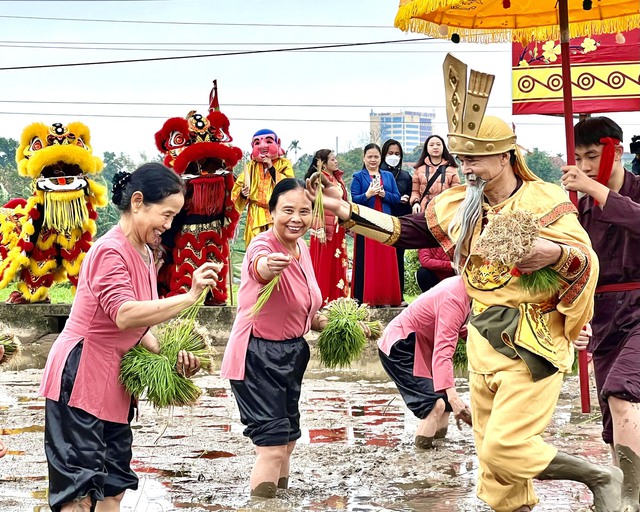
The Vua Hùng Teaching Rice Cultivation Festival is held annually on the 14th and 15th days of the first lunar month, in the Lú field. This event marks the beginning of a series of activities leading up to the Hùng Kings’ Commemoration and the Đền Hùng Festival in 2023.
The festival consists of two parts: the ceremony, including traditional rituals of proclamation and offerings to Thần Nông (the God of Agriculture), conducted on the 14th day of the first lunar month. The main festival takes place on the 15th day, featuring a procession, ritual offerings, the worship of Vua Hùng, and a reenactment of the scene where Vua Hùng teaches rice cultivation. This is carried out with the participation of local authorities, the leadership of Minh Nông Ward, and the active involvement of the community. The festival also includes rice planting competitions among teams and traditional folk games involving local residents and visitors.
According to the Hùng Kings’ legend, upon noticing the fertile soil after each flooding season, Vua Hùng summoned the people to teach them how to build embankments to control water. One day, Vua Hùng’s daughters went fishing by the river, observing flocks of birds flying across the field. Suddenly, a bird dropped a bunch of rice flowers onto the hair of one of the princesses, Mị nương. She brought the rice flowers to her father, and Vua Hùng considered it an auspicious sign. He instructed the princesses to spread the rice flowers in the fields.
In spring, Vua Hùng and the people sowed the seeds in the fields. Vua Hùng went to the field, used a sharp stick to poke holes for the seeds. When the rice sprouted, the people did not know how to cultivate, so Vua Hùng pulled up the seedlings, took them to the terraced fields, waded into the water, and demonstrated rice cultivation for the people to observe. The princesses and the people followed suit. In later generations, people remembered the contributions of Vua Hùng, honoring him as the agricultural ancestor and establishing the Tịch Điền Temple facing southwest, right on the mound where Vua Hùng sat while teaching rice cultivation. They named the grain storage hill Lúa, the rice field hill Rơm, and the market Chợ Lú in present-day Minh Nông Ward.
To preserve and promote the distinctive cultural heritage of the Hùng Kings era, in 2018, the People’s Committee of Viet Tri City organized the restoration of the Vua Hùng Teaching Rice Cultivation Festival after comprehensive research on the history and traditional customs. This revival aims to express gratitude for the significant contributions of the Hùng Kings in pioneering the agricultural profession during the nation’s early days. Additionally, the festival contributes to preserving the unique intangible cultural heritage in Viet Tri City.
The representative rituals of the festival, symbolizing the agricultural profession, are reenacted to honor the diligence and creativity in the labor and life of the people. This has created a unique cultural identity in the lives of the people in the ancient capital of Văn Lang.
Through this initiative, Phú Thọ plans to develop and plan agricultural land use, preserve traditional rice varieties, and create agricultural products to serve tourism and services. It also serves as a foundation for collecting and supplementing valuable artifacts, such as the “divine rice grains,” in the Lú village area, Minh Nông Ward, Viet Tri City.
 1168 Hung Vuong Street, Thanh Mieu Ward, Phu Tho Province, Vietnam
  +84889.30.19.19
  contact@visitphutho.vn


