In the consciousness of every Vietnamese, Lac Long Quan and Au Co, as the parents of the nation, represent the origin of the Vietnamese people. According to legend, Au Co was the daughter of De Lai in Lang Xuong cave (Trung Nghia commune, Thanh Thuy district today). When Au Co was born, a fragrant aroma filled the air, and benevolent clouds appeared in the sky, signaling the arrival of a “Heavenly princess.” Lac Long Quan chose Au Co as his wife and took her to Nghia Linh Mountain, where she laid a hundred eggs that hatched into a hundred sons in the area of Den Ha (present-day Hung Temple).
As the sons grew up, Lac Long Quan told Au Co, “I am of the Dragon lineage, and you are of the Fairy lineage; our destiny together ends here.” Lac Long Quan then took 50 sons to the coast to become fishermen, while Au Co took 49 sons to the mountains to explore the wilderness. She left the eldest son to be the king, and through 18 generations, they were known as the Hung Kings. This legendary story has deeply ingrained the images of the Dragon Father and Fairy Mother in the Vietnamese psyche, symbolizing the ancestral roots of the nation. The worship of Mother Au Co is closely associated with gratitude for the merits of Mother, who led her children to open up new lands.
In the legend, Mother Au Co is portrayed like many other Vietnamese mothers—simple, steady, compassionate, hardworking, and profoundly loving toward her children. After taking her sons to the mountains, Mother Au Co taught the people to cultivate wet rice, raise silkworms, weave fabric, fish, and gather food. Therefore, the image of Mother Au Co is associated with the agricultural civilization, the Mother of the land, the Mother of mountains and forests—a mythical and sacred figure.
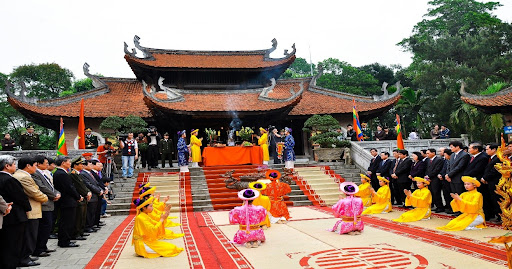
To commemorate the contributions of Mother Au Co and preserve the worship tradition, especially at the Historical Complex of Hung Temple, the Temple of Mother Au Co was initiated in September 2001 and inaugurated in January 2005. The temple’s architecture follows the style of the ancient Dinh characters, facing southeast. Despite being constructed in the 21st century, the Temple of Mother Au Co maintains traditional features, with a boat-shaped curved roof, wooden columns, frames, rafters, walls, and partitions made from ironwood, and a tiled roof made with Bat Trang bricks. Decorative motifs are modeled after Dong Son bronze drum patterns, featuring images of people pounding rice, the Lac bird, stilt houses, and boats.
When visiting the Temple of Mother Au Co at the Historical Complex of Hung Temple, visitors climb 553 stone steps through Three Gates, Pillar Yard, Stele House, up to the main temple with two auxiliary buildings on both sides. In the inner sanctum, there is a worship area with a bronze statue of Mother Au Co covered in gold leaf. The statue embodies and converges the traditional beauty of Vietnamese women: gentle, virtuous, elegant, and serene.
Every year, on significant occasions like Mother Ascension Day (25th of the twelfth lunar month), Mother Descending Day (7th of the first lunar month), and the anniversary of the death of the National Ancestor Lac Long Quan (March 6th lunar calendar), the Historical Complex of Hung Temple organizes grand ceremonies. According to traditional rituals, offerings typically include square sticky rice cakes, cylindrical sticky rice cakes, pig head terrines, flat round sticky rice cakes, wrapped betel leaves, and colorful flowers. Not only on major occasions, but throughout the year, especially during the spring months, the Temple of Mother Au Co receives a large number of people and tourists who come to visit, burn incense, and express their deep respect for Mother Au Co.
Ms. Pham Thi Hoang Oanh, Deputy Director of the Historical Complex of Hung Temple, notes that coming to Hung Temple to light incense at the altar of Mother Au Co and the National Ancestor Lac Long Quan—those who gave birth to the Vietnamese community and remembering the Hung Kings—has become a longstanding cultural beauty, expressing the virtue of filial piety, gratitude, and the philosophy of “people have ancestors, have a lineage.” Hung Temple is a convergence point of complete spiritual essence, a center for practicing the ancestral worship beliefs of every child carrying the Lac Hong bloodline. Every year, around March, Hung Temple welcomes millions of Vietnamese back to pay homage, burn incense, and pray for blessings from the Dragon Father, Fairy Mother, and the Hung Kings, ensuring the enduring prosperity and happiness of Vietnam.
 1168 Hung Vuong Street, Thanh Mieu Ward, Phu Tho Province, Vietnam
  +84889.30.19.19
  contact@visitphutho.vn


