Phú Thọ is not only famous for its landscapes, traditional festivals, and deep Xoan tunes but also for its many simple, rustic specialties with the unique flavors of the Ancestral Land.
“Palm trees and tea hills, lush green fields,
The brilliant sun on the Lô River, echoing the folk songs.”
For a long time, palm trees have been a familiar image in the homeland of Phú Thọ. Wherever you go in Phú Thọ, you can see plenty of palm trees. Palm gardens, palm nurseries, and palm forests follow each other, absorbing the quintessence of the land and sky, growing robustly with strong trunks, ignoring storms and growing tall, budding, flowering, and bearing fruit.

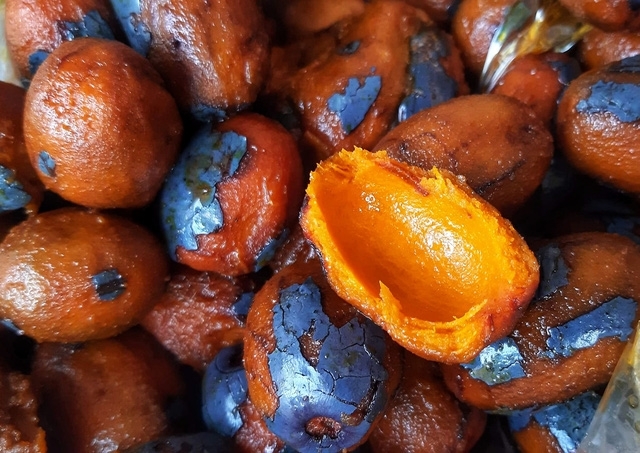
The remaining palm forests are currently concentrated in some districts such as Phù Ninh, Cẩm Khê, Hạ Hòa, and Đoan Hùng in Phú Thọ province. Besides using palm leaves for weaving hats and thatching roofs, palm fruit can be processed into many delicious and famous dishes such as palm leaf rice balls, palm sticky rice, palm squash, but the best, simplest dish that still preserves the characteristic flavor is the “cọ ỏm” dish.
Palm fruit is selected, mixed, and rubbed to remove the outer shell. After cleaning, it is taken for “ỏm”. The “ỏm” process is also an art. One does not “ỏm” palm fruit when the boiling water is bubbling because the fruit will shrink due to the excessively high temperature. Palm fruit cannot be “ỏm” for too long either. When the water surface shows yellowish patches and the green palm fruit turns yellow, it is done. In the process of making “cọ ỏm,” the most important factors are the temperature of the water and the stewing time. When the boiling water is simmering, add the palm fruit, cover the pot, simmer over low heat, letting the water roll gently. Skillful hands are those that can control these factors to produce thick, soft, chewy bites that are not too bitter. If the fire and water are not right, the palm fruit will be bitter and tough, making it difficult to eat.

As a fruit characteristic of the Ancestral Land, palm fruit is neither sweet nor refreshing. Hidden in that tiny fruit is a bitter taste, a chewy taste very characteristic of the locals, with a hint of mist and the scent of algae, carrying profound sentiments. “Cọ ỏm” is a simple, easy-to-make dish, but it attracts many people due to its unique taste.
There are many types of fruit present in the lives of the people of Phú Thọ. Amidst countless sweet and fragrant fruits, palm fruit brings a very distinctive and unique aroma. Not sweet, not fragrant, but the bitter and rich taste of this tiny fruit makes it unforgettable. When visiting Phú Thọ during the palm fruit ripening season, visiting a local’s house, tourists will easily see how to make “cọ ỏm.”

Simple-looking dishes are not easy to replicate everywhere, and not everyone can capture their true flavor. Come to Phú Thọ, the land of the palm hills, to fully enjoy the rich, chewy flavor of “Cọ ỏm” – a Phú Thọ specialty, a delicious dish from the Ancestral Land.
 1168 Hung Vuong Street, Thanh Mieu Ward, Phu Tho Province, Vietnam
  +84889.30.19.19
  contact@visitphutho.vn


