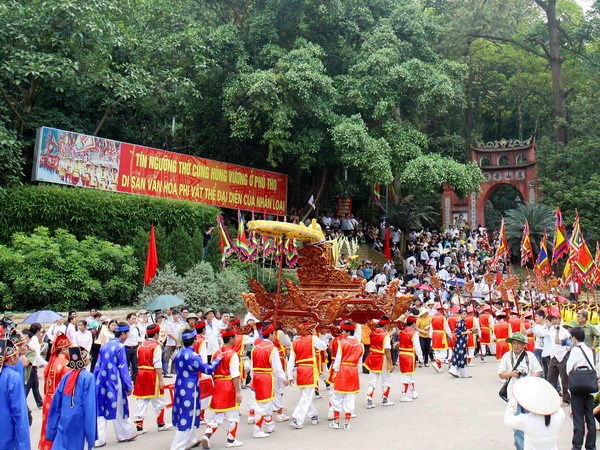
1.”Cult of Worshiping Hung Kings in Phu Tho” :
On December 6, 2012, during its 7th session, the Intergovernmental Committee for the Safeguarding of the Intangible Cultural Heritage officially recognized the “Cult of Worshiping Hung Kings in Phu Tho” as the intangible cultural heritage representative of humanity, in accordance with the 2003 Convention. This marked the first time a cultural heritage of Vietnam was honored in the category of religious beliefs.
The “Cult of Worshiping Hung Kings in Phu Tho” is an ancient ritual that has become a significant tradition, reflecting filial piety, gratitude, and the philosophy of “People have ancestors and a lineage.” Despite the vicissitudes of the nation’s history, the cult of worshiping Hung Kings holds a sacred position in the spiritual life of the Vietnamese people, permeating every family and community, serving as a focal point for the unity of the entire nation.
According to statistics, there are currently over 1,400 historical sites dedicated to worshiping the Hung Kings and related figures from the period of nation-building and defense under the reign of the Hung Kings. In Phu Tho province alone, there are 345 such sites associated with the worship of the Hung Kings and figures from the era in Vietnam. Among them, the Hung Temple is the largest and oldest center for practicing the ritual of worshiping the Hung Kings in the country. Throughout the ages, on the 10th day of the lunar month of March, Vietnamese people continue to make pilgrimages to the ancestral land to express gratitude to the Hung Kings—those who contributed to the establishment and defense of the nation.
2. “Xoan singing of Phu Tho”:
“Hát Xoan is a precious intangible cultural heritage of the ancestral land, specifically, and a part of the cultural heritage treasure of the Vietnamese nation as a whole. Hát Xoan is a form of ceremonial folk singing, a ritualistic tradition, also known as ‘Khúc môn đình’ or ‘Gate Song,’ representing a multi-faceted art form that includes singing, music, and dance to serve the religious needs of the community. With a rich history, a well-organized artistic structure, extensive cultural space, and strong community influence, Hát Xoan holds global significance. On November 24, 2011, during the 6th session of the UNESCO Intergovernmental Committee for the Safeguarding of the Intangible Cultural Heritage held in Bali, Indonesia, the dossier on Hát Xoan – Phu Tho, Vietnam, was officially recognized as an urgent safeguarding intangible cultural heritage of humanity.
On December 8, 2017, during the 12th session of the UNESCO Intergovernmental Committee for the Safeguarding of the Intangible Cultural Heritage, Hát Xoan Phu Tho was officially removed from the list of items in need of urgent safeguarding and became the representative intangible cultural heritage of humanity. This is the first and only case in UNESCO’s history. This event marked the initial success of Phu Tho province and the community’s efforts and determination to fulfill their commitment to protecting the Hát Xoan heritage over the past six years.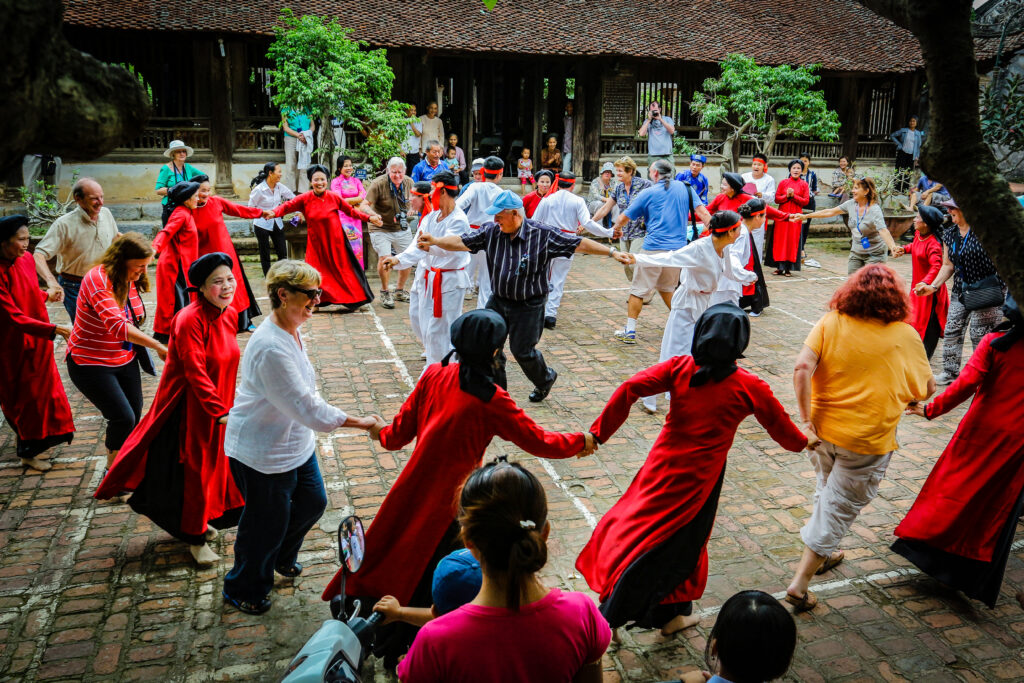
Hát Xoan is currently practiced in 18 communes in the provinces of Phu Tho and Vinh Phuc, including 15 communes and wards in the city of Viet Tri, Phu Ninh, Lam Thao, Tam Nong, and Doan Hung districts (Phu Tho province), and 3 communes in the districts of Lap Thach, Song Lo, and Vinh Tuong (Vinh Phuc province). In Phu Tho province, there are four Xoan wards established according to the decision of the Department of Culture, Sports, and Tourism, actively operating in the city of Viet Tri. These wards are Xoan An Thai, Xoan Thet, Xoan Phu Duc, and Xoan Kim Dai.”
 1168 Hung Vuong Street, Thanh Mieu Ward, Phu Tho Province, Vietnam
  +84889.30.19.19
  contact@visitphutho.vn


