Located along the banks of the Thao River, the village of Hà Thạch, known for its production of cakes and noodles, in Phú Thọ town has a long-standing history and is renowned for its many hometown specialties, especially the cakes with a history of hundreds of years. Despite facing various difficulties, the local people have managed to preserve their traditional crafts, with Hà Thạch’s Tẻ cake standing out for its distinctive flavor, reminiscent of childhood memories and the challenging years that evoke endless nostalgia in today’s increasingly busy and rushed lifestyle.
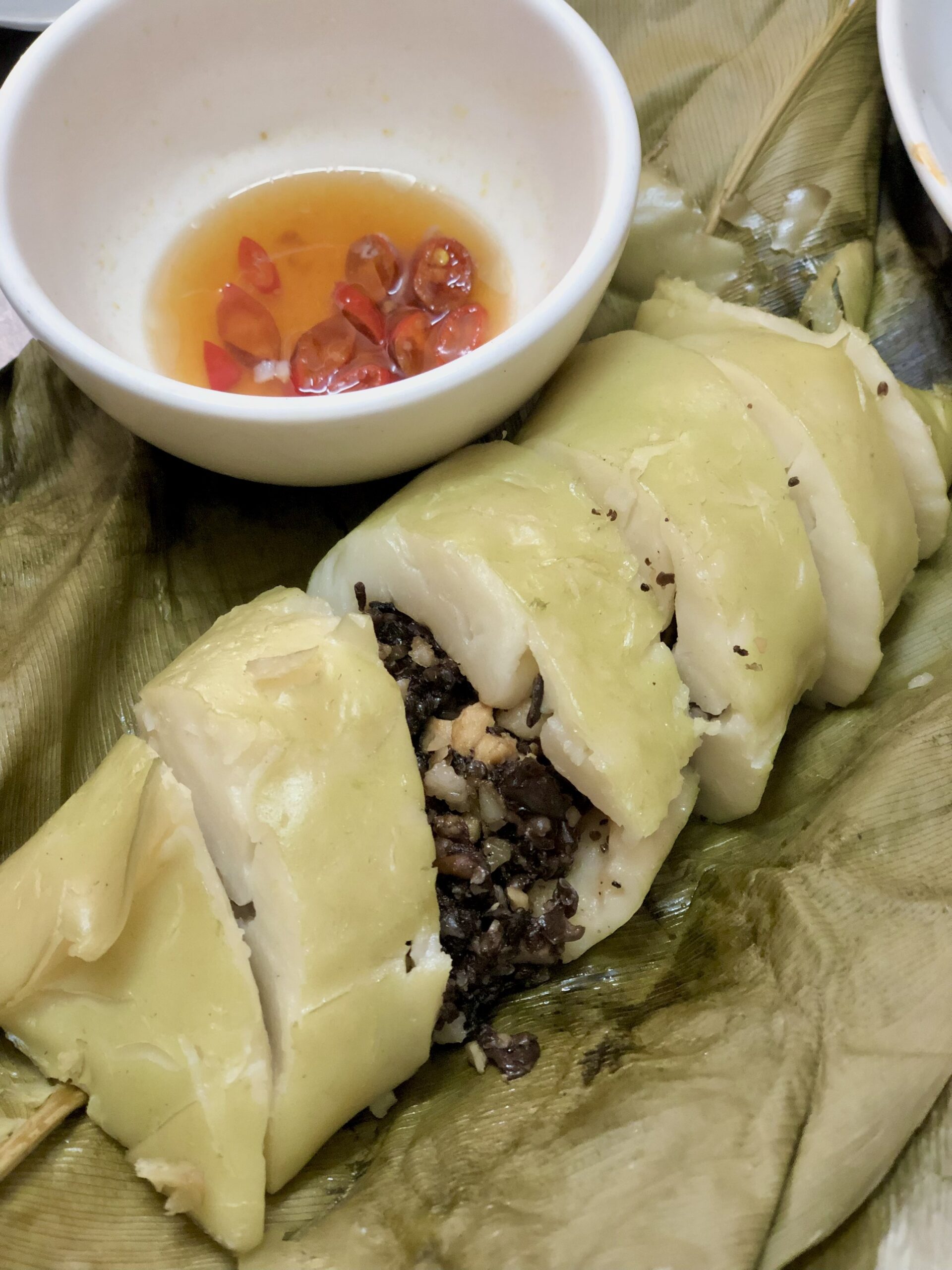
Tẻ cake, as its name suggests, is made from tẻ rice, filled with pork, onions, and mộc nhĩ (a type of herb) – the simplest and most common ingredients in the daily meals of the people in the Red River Delta region, and especially in Phú Thọ
Simple and fragrant Tẻ cakes
To make Tẻ cakes, the rice is soaked and ground into a smooth water batter. After grinding, pour the batter into a large pot, place it on a small fire, and stir by hand until the batter becomes smooth and reaches the right consistency. This process, known as “chín dở” or “ripening,” is crucial for the success of the cake. The batter must be even, free of lumps and clumps.
Stirring the batter until it thickens
For the filling, pork belly is mixed with mộc nhĩ and cleaned, finely minced onions. The mixture is seasoned with ground pepper and good quality fish sauce, then stir-fried until cooked. The key to a delicious Tẻ cake lies in the quality of the ingredients, such as choosing the best rice, fresh pork, and high-quality spices. The rice used for making the cake must be the finest and most fragrant, as it is a crucial factor in the cake’s taste. The meat, including pork belly, mộc nhĩ, pepper, and onions, must also be of the highest quality. Fresh pork is essential, as using spoiled meat would diminish the cake’s flavor, making it less tasty and prone to spoilage.
To produce a complete Tẻ cake, two main steps are involved: making the cake cover and making the filling. The most intricate step is making the cake batter. The good quality tẻ rice is soaked for a few hours and then ground into a fine powder. When the powder is ready, pour it all into a large pot over a small fire, stirring by hand to make a smooth batter that is just starting to cook. The stirring process requires strong hands, as it determines the success of the cake. The batter must be evenly cooked, without clumps or lumps.
Image
Ingredients for Tẻ cake filling
As for the cake cover, dong leaves are carefully washed several times with clean water, allowed to drain, and dried with a clean cloth. When the batter meets the requirements, scoop it onto dong leaves, spreading the batter along the leaf like a boat, add the filling in the middle of the layer of batter, then fold the leaf along its length, pressing the two ends of the leaf together and rolling tightly to create the appearance of a “răng bừa” (rough tooth). The resulting cake is elongated, not perfectly square like chưng cake, not too large like giò cake, and not perfectly round like giày cake. It is slender at the ends, slightly swollen in the middle, and is tied with string or rolled along the cake’s body.
Image
Process of spreading batter, adding filling, and rolling the cake
The process of making Tẻ cakes demands meticulousness and considerable time. However, once skilled, a person can make hundreds of cakes. After wrapping, the cakes are steamed for about 60-70 minutes, then taken out to drain. According to cake makers, the steaming step is crucial. If the fire is too high or the cakes are steamed too much, they will become mushy or undercooked. Proper steaming ensures that the cakes are firm, crispy, and cooked evenly.
Image
Steaming the cakes until fully cooked
The finished product, with a slightly green color from the dong leaves, is smooth, taut, and emits a fragrance of rice blended with the scent of dong leaves. The cakes have a beautiful shine, a delicious, crispy, fragrant taste, and the filling releases an appealing aroma. Peeling off a hot and steamy Tẻ cake, eating it immediately with chili sauce or dipping it in a sauce made from good-quality fish sauce mixed with finely ground chili, pepper, lime, garlic, and chili is an experience of unique, delicious, and tempting flavors that only Hà Thạch’s Tẻ cake can offer.
Image
Irresistibly delicious, hot Tẻ cake
When savoring this dish, everyone can feel its simplicity, rusticness, and a rich, charming taste, a blend of flavors that is interesting, crispy, and soft. Eating it once makes you want to eat it again. This type of cake can replace breakfast or snacks. The delicious, pure-white cakes, filled with the maker’s sentiments, remain soft even when eaten cold, not becoming hard, ensuring that the cake is not monotonous or boring.
During festivals, Tet, weddings, and throughout the year in Phú Thọ town, Tẻ cakes are frequently present and favored because they are easy to eat, satisfying, and nutritious.
Today, Hà Thạch’s cake-making village and services have more than 20 households producing Tẻ cakes, selling thousands of cakes every day throughout the province. Depending on the type and size, prices range from 7,000 to 15,000 VND per cake. The people of Hà Thạch put their whole hearts into making these cakes, not only for a livelihood but also to preserve the traditional cultural essence of their homeland for hundreds of years.
Nowadays, Hà Thạch’s Tẻ cakes are widespread, and they can even be purchased in Hanoi. As a genuinely rustic and down-to-earth countryside gift, this cake, when placed in your mouth, allows you to feel the crystallization of heaven and earth.
This simple and soulful snack holds a mysterious attraction, not only for children and the elderly but also for all travelers who happen to try it. If you have the chance to return to the ancestral land, to Phú Thọ town, remember to buy this cake as a gift for your loved ones.
 1168 Hung Vuong Street, Thanh Mieu Ward, Phu Tho Province, Vietnam
 +84889.30.19.19
 contact@visitphutho.vn


