When mentioning Dao Xa village (now Dao Xa commune, Thanh Thuy district, Phu Tho province), many people would instantly think of the traditional elephant parade festival held from the 27th to the 29th day of the Lunar New Year. This festival reflects the historical values, cultural activities, rice farming beliefs, and water deity worship of the residents in the Ancestral Land region. Particularly, there is a type of cake that cannot be absent from the offering tray to Thanh Hoang (the deity in charge of protecting the village) during the festival, and that is the “Te Mat” cake. This is a traditional and familiar dish of the people in Dao Xa village, leaving a deep and unique impression on many festival-goers.
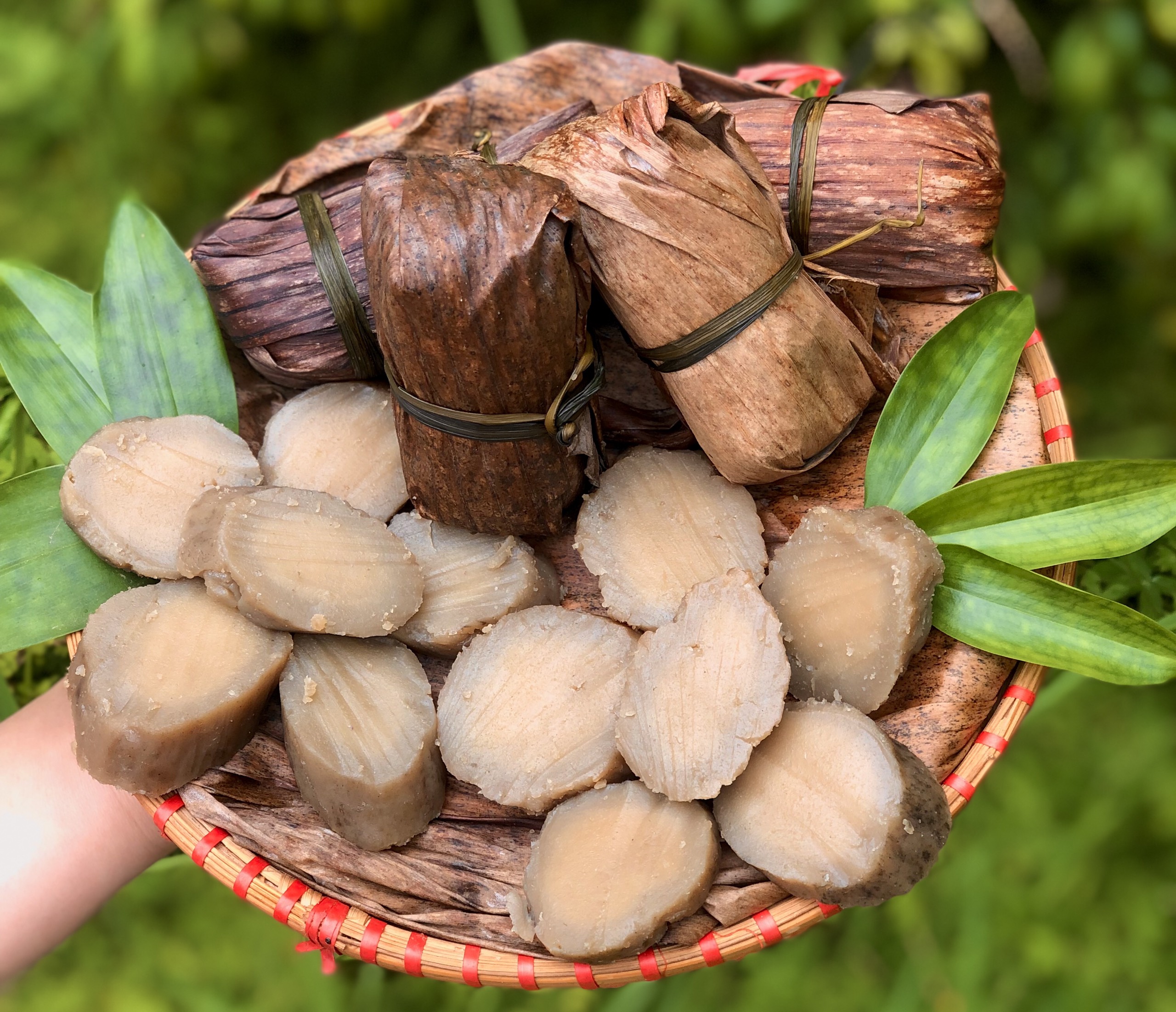
As simple as its name, Te Mat cake is made from sugarcane molasses and brown rice flour, a type of rice that the locals metaphorically call “the mother of rice,” creating a very special and delicious flavor. Making a Te Mat cake is not difficult at all, as this type of cake does not require any complicated procedures—it just needs a bit of dedication.
The process of making Te Mat cake involves four steps: preparing the ingredients, stirring the cake mixture, wrapping the cake, and steaming the cake. According to the experience of the people in Dao Xa village, to make a delicious Te Mat cake, one should choose pure brown rice, free from impurities, preferably local brown rice. The molasses used for the cake should be thick and aromatic sugarcane molasses, preferably with a dark color. The wrapping leaves for the cake should be dried banana leaves and other suitable types of leaves, vines, etc. The distinctive feature of Te Mat cake from Dao Xa is that it does not include any filling.
Three main ingredients for Te Mat cake
After preparing all the ingredients, the rice is cleaned and soaked for about a day before grinding. In the past, people in Dao Xa village had to manually grind the rice with stone mortars, making the process slow and arduous. However, nowadays, there are grinding machines, making the task much quicker. The Te Mat cake batter should be dense and smooth; if the batter is too sticky, it will be difficult to wrap, and when eaten, it will lack the necessary firmness, making it easy to become unappetizing. The molasses are mixed with water and fresh ginger to enhance the aroma, then stirred evenly with the rice flour. Depending on personal preference for sweetness, one can adjust the amount of molasses accordingly.
Next, the batter is placed in a pot over a medium heat, stirred quickly, vigorously, and continuously until the cake mixture becomes cohesive. After that, the pot is covered tightly and left to ferment on a low heat until the cake batter is thoroughly cooked. During this crucial step, turning, beating, and rotating the batter consistently under low heat is essential. If not done carefully, the batter may not cook evenly and may stick to the bottom of the pot, creating uneven and lumpy cakes.
Stirring, shaping, and wrapping Te Mat cakes
While the batter is still hot, it is quickly scooped out, shaped into small cakes, and then placed on cleaned and dried banana leaves. The cakes are rolled up, tied at both ends like square-shaped “chung” cakes, or tied with leaves, creating a flat shape similar to salty Te cakes. The cake wrappers need to work quickly, gently, and skillfully to ensure that the last cake still has hot batter, as if the batter cools down, the steamed cakes will not cook evenly, will not be smooth, and will lack a shiny appearance. Once wrapped, the cakes are placed on a steaming pot; when the pot’s steam rises evenly, a burning incense stick is lit, and the fragrance of the incense will indicate the cakes are fully cooked. According to the experience of those who have been making Te Mat cakes for years, the steaming process not only ensures thorough cooking but also makes the cakes smoother and firmer. The cakes will have a golden brown color, a result of the sugarcane molasses and dried banana leaves.
Cakes being steamed to perfection
After steaming, once the cakes have cooled, they are cut into small pieces. Te Mat cakes have a shiny golden color like honey, exuding a cool, fresh, and gentle fragrance. When tasted, the touch of the cake on the tongue brings a refreshing and sweet sensation, very interesting indeed. The cakes have a moderately soft and chewy texture, with the slightly rough taste of brown rice flour, along with the cool sweetness of sugarcane molasses and the aromatic scent of ginger, all blending together in a mouthwatering way. Enjoying a piece of Te Mat cake suddenly brings back memories of childhood, as if the flavor of this cake carries the essence of the countryside.
Plate of fragrant and delicious Te Mat cakes
For generations, Te Mat cakes from Dao Xa have been considered a “delightful” dish for everyone— a simple, rustic, and everyday gift from the people of Dao Xa village. The Te Mat cake has become a traditional beauty of the people in Dao Xa village, a simple and rustic dish that reflects the firmness of the people in Dao Xa village. Especially, during the village festival, in addition to sticky rice, sweet soup, chicken, fruits, etc., there are always two plates of Te Mat cakes on the offering tray to Thanh Hoang, praying for favorable weather, abundant crops, harmony in the village, and a warm, happy life.
In the midst of today’s bustling and busy life, eating a piece of Te Mat cake feels like a flood of childhood memories. The taste of this cake seems to bring along the fragrance of the countryside wind.
Te Mat cake is a delicious and captivating dish that contributes to the formation of the rich culinary culture of Thanh Thuy’s homeland. Although truly rustic and simple, it truly awakens and deepens the profound love for the homeland, the pride in each resident of Dao Xa village for the land that has nurtured countless generations. If you have the opportunity to visit Phu Tho, do not forget to savor the traditional Te Mat cake from Dao Xa village, from this Ancestral Land.
 1168 Hung Vuong Street, Thanh Mieu Ward, Phu Tho Province, Vietnam
 +84889.30.19.19
 contact@visitphutho.vn


