Yên Lập is a mountainous district in Phú Thọ Province, home to various ethnic groups such as the Mường, Dao, Tày, each with its own cultural characteristics, musical instruments, customs, and traditional festivals, creating a diverse and colorful cultural landscape. Accounting for over 70% of the population here, the Mường people still preserve some traditional folk cultural features that reflect their ethnic identity, among which the art of “Múa Trống Đu” (Swinging Drum Dance) stands out as one of the most distinctive folk performances.
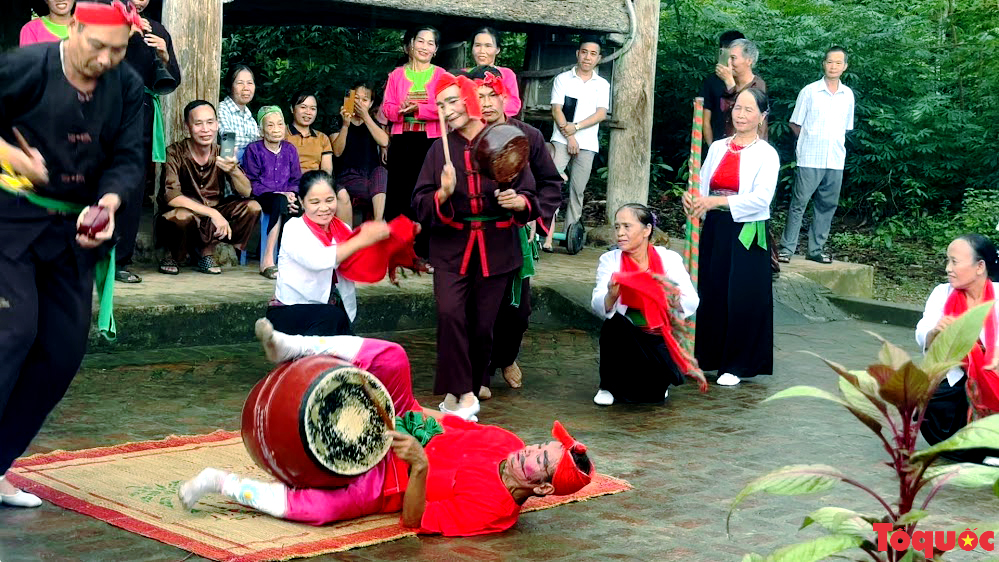
Múa Trống Đu is also known as Trống Đua or Trống Đùa. Its significance originated from a true story in folklore. The tale tells of a Mường couple who gave birth to a son. While their lives were happy, the wife fell ill and passed away. Overwhelmed with grief, the husband bought a drum from a neighboring village to console and distract his young son, who incessantly cried for his mother. The drum became a source of comfort, symbolizing the bond between father and son. When the father passed away, the son organized a drum dance to bid farewell to his father. Over time, the name “Trống Đu” emerged, evolving from a means to express longing for a loved one to an indispensable dance in longevity celebrations, Tet festivals, spring festivals, and community cultural activities of the Mường people in Yên Lập.
The drum is made from buffalo hide, with a diameter of about 30cm and a length of 45cm, providing enough space for the dancer to swing, rotate, and handle the drum easily. Initially performed by two people symbolizing the father and son, the number of dancers increased to serve the community during communal activities or festive seasons. Today, a Trống Đu performance can involve up to eleven participants, including a main drummer, a secondary drummer, two performers doing acrobatics, two flute players, and six female dancers. To commence the dance, the main drummer enters the stage, bows to the audience, and begins drumming. The rest of the team, representing the wings of a chicken, gradually joins in. When the second drum emerges, the team members, holding pairs of “sênh tiền” (wooden or bamboo instruments designed to produce distinctive sounds), synchronize their movements with the drum’s rhythm and perform traditional Mường-style dance steps.
The Performance and Costumes
The dancer and accompanying performers stand in the center, dancing and drumming to ensure the drum’s beat aligns with the dance movements and the supporting musical instruments. The rhythm of Múa Trống Đu varies between intense and rhythmic, creating a blend of poignant and powerful sounds. It reflects aspirations for a prosperous and happy life, showcasing unity within the community, breaking down social boundaries. It represents the longing for a future of happiness, peace, and prosperity for the working people.
In addition to the famous Fox Lake (in Thượng Long commune), historical relics, and cultural heritages like the Revolutionary Base of Phục Cổ (in Minh Hòa commune) and Tôn Sơn Base – Mộ Xuân (in Xuân An commune), visitors to Yên Lập can explore intriguing aspects of the traditional festivals of the Mường and Dao people. These include ceremonies such as closing and opening the forest, entering a new house, health-related rituals, blessing ceremonies, celebrating new rice, inauguration ceremonies, and festive dances such as gong performances, hát giang (singing competition), hát ví (duet singing), múa mỡi (invitational dance), and trống đu.
Múa Trống Đu, like a vibrant flower, adds a distinctive touch to the garden of traditional folk arts, enriching the cultural tapestry of the Mường ethnic group. It becomes an indispensable cultural and spiritual feast for the people of Yên Lập during each Tet holiday and spring season.
 1168 Hung Vuong Street, Thanh Mieu Ward, Phu Tho Province, Vietnam
  +84889.30.19.19
  contact@visitphutho.vn


