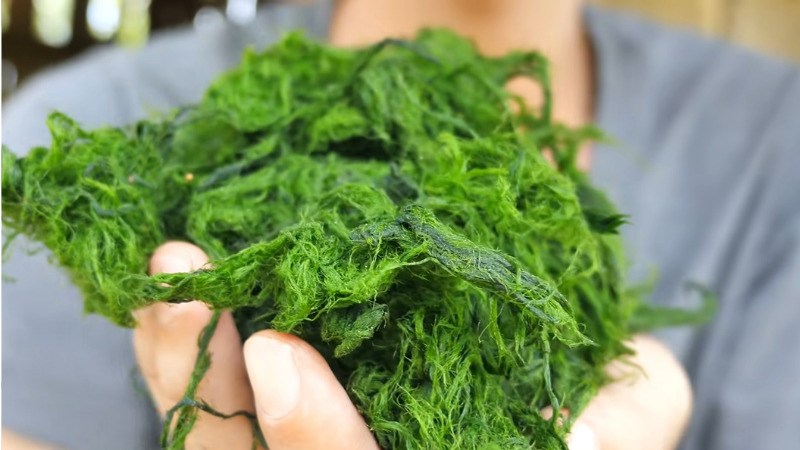
Amidst the myriad challenges of nature and the cyclical dance of the earth and sky, there is a plant that submerges itself underwater all year round, its roots clinging to rocks for survival, defying all the challenges of nature. That plant is moss, specifically moss growing on rocks – a traditional food of the Muong and Dao ethnic groups.
According to history, over thousands and tens of thousands of years, nature and humans have always had a close and symbiotic relationship. Nature, like a nurturing and protective mother, nurtures, shields, and fosters human existence and development. This harmony has left us with vibrant cultures with a distinct identity. In the cradle of such culture, Phú Thọ is not only famous for its ancient historical relics, the birthplace of ethnic roots, but also known for “coconut forests and tea hills,” local products, simple and rustic dishes, and warm and hospitable people.
Located in the mountainous district of Tân Sơn, Phú Thọ province, Đồng Sơn commune in Tân Sơn is known for its famous local product – moss on rocks. It’s a simple and rustic dish yet equally attractive, carrying the ethnic identity of the local people.
The moss harvesting season starts from September to the end of May in the lunar calendar every year. Moss grows in patches, depending on whether the rocks are large or small, and it can be more or less green, depending on whether it grows in deep or shallow streams. When harvesting moss, people must choose downstream so that the moss does not break. Only the tender and clean part of the stem is selected, without uprooting the whole plant. After harvesting, the moss is taken to large rocks by the stream, beaten with a wooden stick until it softens, then rinsed thoroughly under the cool, clear stream. Beating the moss requires precision and skill. After the preliminary processing, the moss can be used for daily meals, or it can be sun-dried for gradual consumption or reserved for important occasions such as weddings, house construction, or hosting esteemed guests.
Moss on rocks, grilled (Photo: Collected)
There are various ways to prepare moss on rocks, such as boiling, steaming, making soup, or making salads. However, the most special and attractive dish is grilled moss. After being cleaned, the moss is marinated with spices such as fish sauce, salt, garlic, chili, ginger, lemongrass, and mac khen seeds (a distinctive spice of the mountainous region). Then it is mixed with meat, sometimes with a bit of fat. The best way to grill moss is to wrap it in forest leaves or put it in a non-stick bamboo tube, then grill evenly over a red-flame charcoal stove. The spicy and aromatic taste of the spices combined with the richness of the meat and the subtle fragrance of the moss will surely leave a deep impression on diners when they first taste this unique dish.
Moss on rocks is not just a rustic dish, closely tied to daily life, but also carries the distinct cultural identity of the Muong and Dao ethnic groups in the mountainous district of Tân Sơn. Visitors here will get to experience and enjoy the unique taste of this traditional dish. The diversity and richness of cultures have contributed to the uniqueness of the culinary culture of the Vietnamese ethnic groups.
 1168 Hung Vuong Street, Thanh Mieu Ward, Phu Tho Province, Vietnam
  +84889.30.19.19
  contact@visitphutho.vn


