Situated along the Đà River, Thanh Thủy not only possesses the advantage of developing tourism but is also an area rich in cultural and historical relics, fostering the development of cultural and spiritual tourism. Among them, the prominent festivals include the cotton-snatching ceremony at La Phù Temple and the unique architecture of Hạ Bì Trung Temple, recognized as a national-level architectural relic by the Ministry of Culture, Sports and Tourism. When visiting Thanh Thủy in the early spring, tourists immerse themselves in the atmosphere of traditional folk cultural festivals with unique local cultural features.
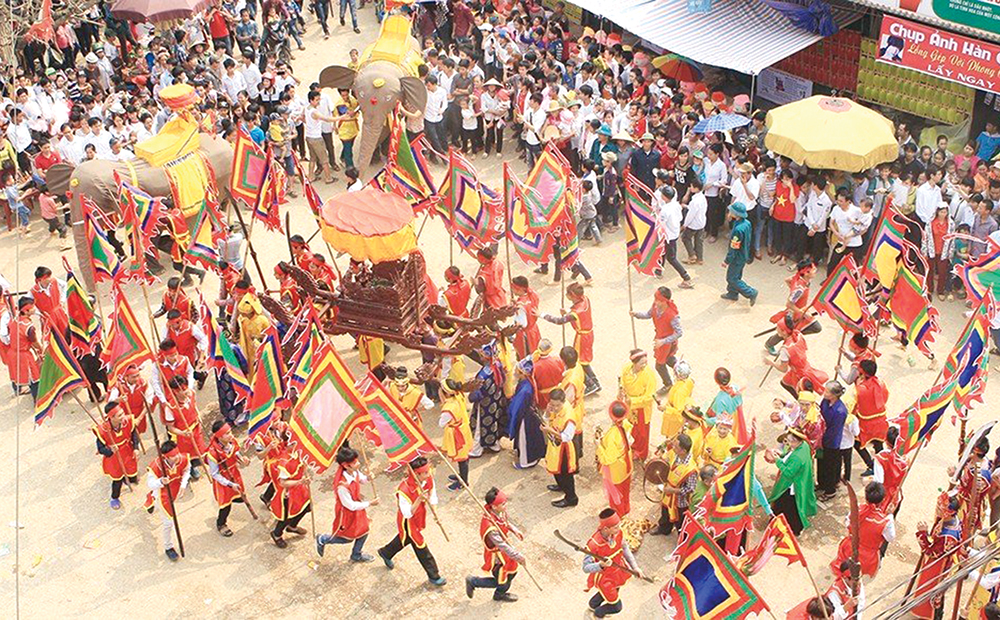
Located in Xuân Lộc commune, Hạ Bì Trung Temple worships Tam Vị Đại Vương of the Hùng Dynasty: Tản Viên Sơn Thánh, Cao Sơn Đại Vương, and Quý Minh Đại. These figures contributed to helping King Hùng Duệ Vương pacify the Thục invaders and protect the country. Historical records mention that the temple was constructed in the late 18th century with bamboo and palm leaf paintings. After the villagers moved the temple from the right bank to the left bank of the Đà River in the Đinh Hợi year of 1827, the temple was elevated on a flat ground facing southeast. The Grand Hall has a unique architecture with a single structure, three compartments, two lean-tos, made of precious woods such as ironwood, lim, and jackfruit. The temple still preserves dragon statues, horizontal lacquered boards, couplets, and royal edicts. Items for worship, including incense burners, bowls, plates, and vases, remain intact. Hạ Bì Trung Temple was recognized with the fifth rank by the Nguyễn Dynasty in 1853 and 1943. The temple’s design is meticulously carved and sophisticated, expressing the desire for a prosperous life of the local people. The main festival of the temple occurs on the 8th day of the 10th lunar month, marking the birth and death anniversaries of the Holy Mother.
Undergoing historical fluctuations, environmental impacts, and wars, Hạ Bì Trung Temple deteriorated significantly. In 2007, the villagers carried out a major restoration of the Grand Hall under the guidance of the Department of Culture and Information of Thanh Thủy district and the Department of Culture, Sports and Tourism. The original features of the relic were preserved, with nearly 1 billion VND raised by the local people, visitors, and philanthropists. In 2010, Hạ Bì Trung Temple was classified as a national-level architectural relic by the Ministry of Culture, Sports and Tourism.
To manage, renovate, and promote the value of the relic, in 2014, the Department of Culture and Information of the district took the initiative to propose projects to the district People’s Committee. They collaborated with the local authorities to plan the renovation of the temple’s components. The district directed the Financial Department and the Infrastructure Economy Department to coordinate with investors in designing and executing the project on schedule. In 2017, the temple’s festival ground was concreted, covering an area of 350 square meters, and some adjacent items were renovated with a budget of 180 million VND.
To enhance the effectiveness of cultural heritage management, preservation, and renovation, the district People’s Committee issued documents to implement the state regulations, such as the Cultural Heritage Law and decrees on managing historical and cultural relics at the communal level. As a result, the awareness of relic management and protection, as well as the self-consciousness of the local people in preserving and conserving cultural heritage, has been elevated. The annual festival has fostered a sense of unity among community members through understanding the origins of the festival, relics, and revered figures.
Unique Cotton-Snatching Festival
Cotton Snatching during the La Phù Village Festival.
According to legend, Tản Viên Sơn Thánh, the son-in-law of the 18th Hùng Vương (Hùng Duệ Vương), was sent by his father-in-law to fight against the Thục invaders to safeguard the land. On his way to the battlefield, he entered La Phù Village in La Phù commune (now Thanh Thủy town) to train the soldiers in martial arts before heading to the frontlines. The village also has a myth about a poor woman named Phan Thị Cù. One hot summer afternoon, she went to the river to bathe and suddenly saw a white snake swimming around her. After returning home, she became pregnant and gave birth to five eggs, which later hatched into five small snakes. One day, while farming, she accidentally cut off the tail of a white snake, turning it into a jade bracelet. Over the years, the five snakes grew into five beautiful children—two girls and three boys. All five children left to explore new lands, establish careers, and protect an area worshipped by the local people as the Thành Hoàng Village Shrine. The third son, honored as Thành Hoàng of La Phù Village, named Cộc, was recognized and awarded by the subsequent royal dynasties. “The virtuous husband and father, who guards five territories, is bestowed with royal recognition, responding to the great king,” as proclaimed in 1853 and 1943. The villagers established a temple to worship him alongside his mother and Tản Viên Sơn Thánh.
Every year, La Phù Temple has five main ceremonies on the 7th and 12th days of the first lunar month, the 3rd day of the third lunar month, the 16th day of the fourth lunar month, and the 8th day of the twelfth lunar month. Among them, the 12th day of the first lunar month is the Spring Award Ceremony and the largest traditional cultural and historical festival of the village.
The festival in La Phù Village consists of two parts: the ritual and the fair. The ritual includes a procession, offering of the five-fruit tray, oil lamps, flag games, etc., from the temple to the Mother’s Tomb for three weeks before returning to the temple for the Thánh Ceremony. After the ritual comes the fair, featuring traditional folk games such as tug of war, duck catching, swimming, etc. There is also the unique cotton-snatching ceremony, reenacting the story of Tản Viên Sơn Thánh training soldiers for the battle against the Thục invaders during the time of Hùng Vương. This is considered a lively and fascinating game with the purpose of training intelligence, strength, and courage for the players. The villagers believe that whoever wins the game and brings the cotton back home to offer to the ancestral altar will bring prosperity, health, and luck to themselves, their families, and the entire neighborhood (now a residential area). This cultural and spiritual beauty is unique and meaningful, deserving preservation and promotion.
The cotton-snatching festival and the Hạ Bì Trung Temple festival have instilled in the hearts of the local people a deep sense of gratitude and respect for those who have contributed to the country and built cultural living traditions. The festivals have also created a strong bond among community members and pilgrims attending the events.
 1168 Hung Vuong Street, Thanh Mieu Ward, Phu Tho Province, Vietnam
  +84889.30.19.19
  contact@visitphutho.vn


