Xuân Sơn commune, nestled in the remote and challenging terrain of Tân Sơn district, is primarily inhabited by the Mường and Dao ethnic groups, who have managed to preserve their indigenous cultural traits without significant external influences. In the hamlet of Bản Cỏi, Xuân Sơn, where 100% of households belong to the Dao Tiền ethnic group, a unique cultural feature is maintained: the art of printing floral patterns on fabric using beeswax.
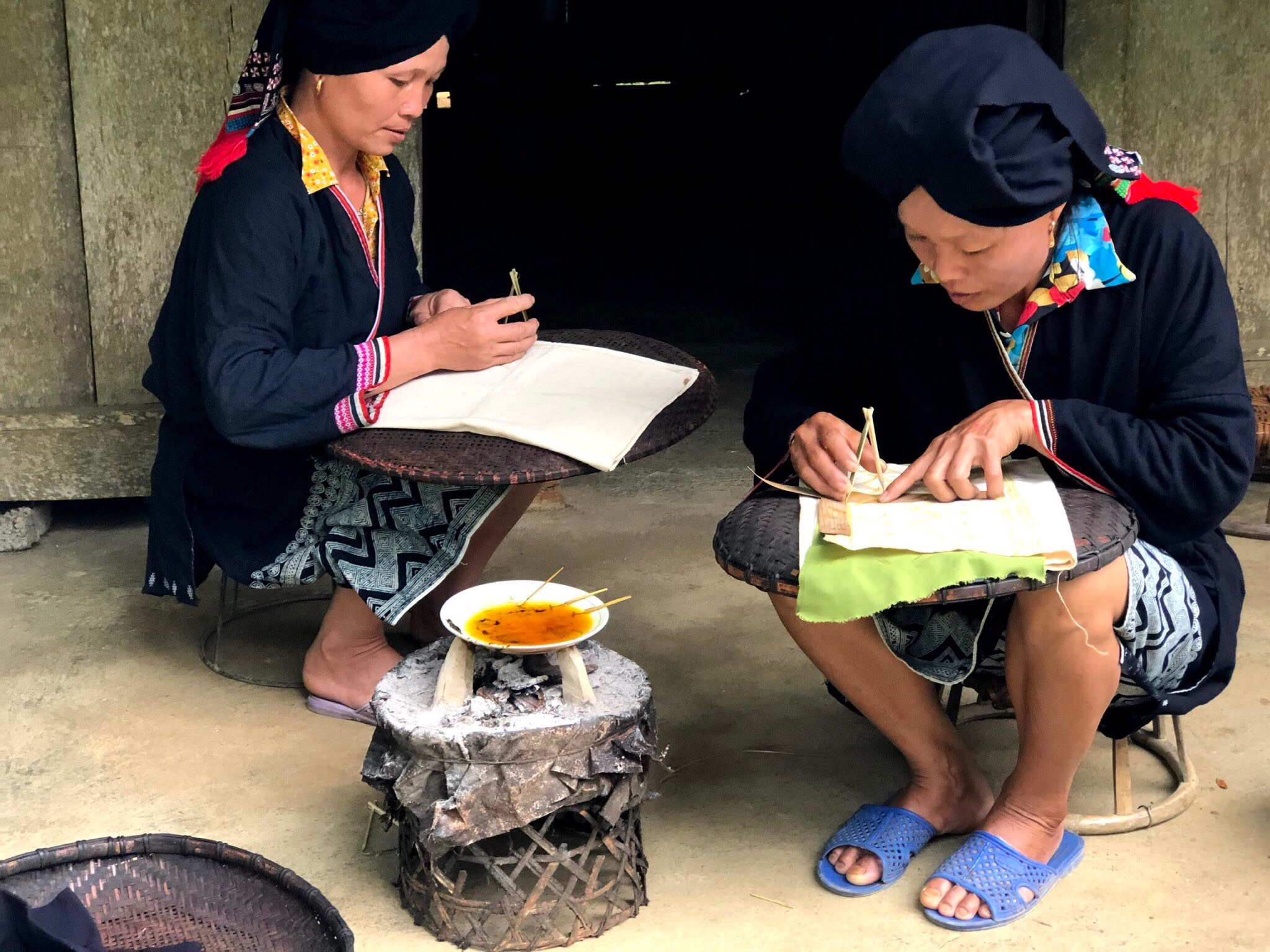
The practice of printing floral patterns on fabric using beeswax stands as a distinct cultural heritage of the Dao Tiền people, not only within the broader region but particularly among the Dao Tiền residing in Bản Cỏi. While Dao individuals nowadays rarely incorporate traditionally patterned clothing into their daily lives—reserving them for special occasions like festivals, ceremonies, or important events—the art of beeswax printing remains a cultural treasure of the Dao Tiền in Bản Cỏi.
Within Dao families, young girls are typically taught the intricate skills of fabric dyeing and beeswax printing around the age of 15 or 16. Upon marriage, they carry with them a few sets of pre-made garments to be utilized in their new households.
To obtain high-quality beeswax for fabric printing, one must extract wax from rare and precious forest beehives. The harvested beehive wax is melted in a pot of water, and after removing the water content, it is left to cool for 2-3 days, forming a smooth wax block. The wax must have the right consistency when heated for fabric printing; if it’s too thick, it won’t adhere to the fabric, and if it’s too thin, the printed patterns will be blurry.
The Printing Process
Once the ideal beeswax is obtained, various thin, triangular-shaped bamboo tools (5-10 pieces ranging from 1-5 cm in size) are prepared for creating patterns of different dimensions. The artist sits beside a fire, dips a tool into the hot beeswax on a pan over the coals, and meticulously draws lines on the fabric. It requires a steady hand to ensure even wax distribution, avoiding smudges, and the artist only re-dips the tool after completing a section of the drawing. After allowing the beeswax to dry, the fabric is repeatedly dyed with a mixture of substances, and then it is dipped into boiling water, causing the beeswax to dissolve, revealing the intricate patterns on the fabric. This multi-step process requires meticulous craftsmanship, resulting in a unique piece of fabric for traditional Dao Tiền clothing.
Artistic Significance
For the Dao people, the floral patterns on their traditional fabric represent their creativity, precision, and meticulousness. Therefore, when a Dao Tiền woman enters her husband’s family, the in-laws and relatives can gauge her cleverness, diligence, and attentiveness to the family by simply looking at her attire. From an early age, mothers and grandmothers pass down the knowledge of weaving fabric and printing floral patterns on traditional attire with great attention to detail. Consequently, the beeswax-printed fabric items carry the distinctive characteristics of the Dao Tiền people through generations.
Although this traditional beeswax fabric printing technique competes with modern industrial fabrics in today’s changing world, it still thrives among the Dao Tiền in Bản Cỏi, Xuân Sơn. The meticulously crafted traditional garments with intricately patterned designs—such as geometric patterns, grass, trees, flowers, leaves, and animal motifs—carry various meanings, reflecting the cultural and religious life of the Dao Tiền ethnic group while highlighting the graceful and simple beauty of Dao Tiền women.
While the lifestyle has evolved with advancements in science and technology, and industrial fabrics have become more popular due to their convenience, the Dao people in Bản Cỏi still preserve and cherish the traditional art of beeswax fabric printing. This art not only honors the cultural value but also establishes a unique identity for the Dao Tiền ethnic group within the community of ethnic minorities in Bản Cỏi, Xuân Sơn.
 1168 Hung Vuong Street, Thanh Mieu Ward, Phu Tho Province, Vietnam
  +84889.30.19.19
  contact@visitphutho.vn


