Xoan singing, also known as “spring songs,” originates from avoiding the word “spring” (xuân) because “xuân” sounds like “huý,” the name of one of King Hùng’s wives. Therefore, when singing at the communal house, the term “xoan” is used.
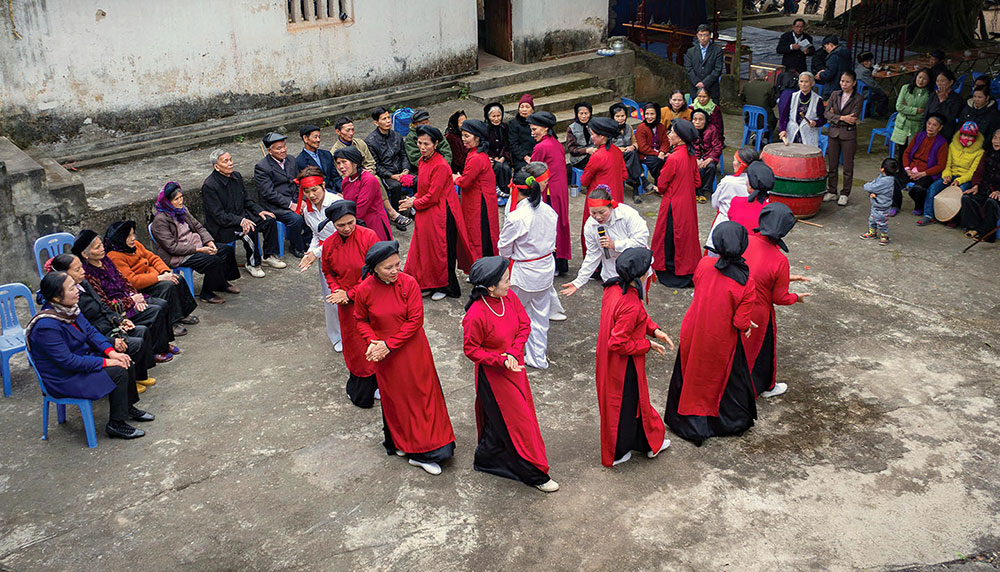
Xoan singing is present in various hamlets such as Kim Đơi, Thét, Trung, and Hội within Kim Đức commune, Phù Ninh district (now part of Việt Trì city). It is also found in An Thái hamlet in Phượng Lâu commune, Việt Trì city, and Cao Mại hamlet in Lâm Thao district, Phú Thọ province.
The tradition of going to sing at communal houses has become long-standing, with participants not motivated solely by livelihood concerns but also by the binding tradition of the “nước nghĩa” relationship between two villages. This reflects the communal spirit of ancient societies. Over time, due to societal developments and demographic changes, this relationship has transformed into a cultural and spiritual connection, involving shared rituals and cultural activities during festive occasions. Xoan singers express their purpose as follows:
“When your village hosts a divine ceremony,
Cao Mại and An Thái, both villages thrive.”
This annual exchange fosters unity among community members and provides an opportunity to understand the origin of the festival, the significance of the communal house, and the revered figures.
The preservation of communal houses in each xoan village underscores the enduring bonds between them. Examining ancient tribal relations, the practice of singing within and beyond the festival has evolved from being purely entertainment to a long-standing tradition, expressing “nước nghĩa” ties between two villages. Although these ties may now be mostly symbolic, they still manifest in cultural and spiritual aspects, such as shared worship of a village’s deities or mutual visits during festive seasons.
In Kim Đức commune, xoan villages are traditionally connected with certain communal houses, such as Phù Ninh, Đức Bác, and Tây Cốc. Likewise, An Thái xoan village is associated with communal houses in Cao Mại and Dữu Lâu. The term “xoan singing” is thus synonymous with “communal house singing.”
Xoan singing is an integral part of cultural ceremonies, linked to seasonal festivities and the worship of Thành hoàng (Divine Guardian). Hence, the historical context and societal characteristics of a specific singing style cannot be separated from its cultural and social roots.
The classification of Phônclo by Guxep refers to ritualistic songs tied to natural forces, agricultural activities, human emotions, and strong desires involving supernatural and mysterious forces. These songs are connected to the worldview of pre-class societies and reflect the consciousness of the general population in class societies.
In summary, Xoan singing is a traditional cultural art form with deep historical and cultural significance, representing the communal bonds and spiritual practices of the people.
Xoan Singing Festival and the Legend of Square and Round Glutinous Rice Cakes in Kim Duc Commune
Xoan singing, also known as “spring songs,” originates from avoiding the word “spring” (xuân) because “xuân” sounds like “huý,” the name of one of King Hùng’s wives. Therefore, when singing at the communal house, the term “xoan” is used.
Xoan singing is present in various hamlets such as Kim Đơi, Thét, Trung, and Hội within Kim Đức commune, Phù Ninh district (now part of Việt Trì city). It is also found in An Thái hamlet in Phượng Lâu commune, Việt Trì city, and Cao Mại hamlet in Lâm Thao district, Phú Thọ province.
The tradition of going to sing at communal houses has become long-standing, with participants not motivated solely by livelihood concerns but also by the binding tradition of the “nước nghĩa” relationship between two villages. This reflects the communal spirit of ancient societies. Over time, due to societal developments and demographic changes, this relationship has transformed into a cultural and spiritual connection, involving shared rituals and cultural activities during festive occasions. Xoan singers express their purpose as follows:
“When your village hosts a divine ceremony,
Cao Mại and An Thái, both villages thrive.”
This annual exchange fosters unity among community members and provides an opportunity to understand the origin of the festival, the significance of the communal house, and the revered figures.
The preservation of communal houses in each xoan village underscores the enduring bonds between them. Examining ancient tribal relations, the practice of singing within and beyond the festival has evolved from being purely entertainment to a long-standing tradition, expressing “nước nghĩa” ties between two villages. Although these ties may now be mostly symbolic, they still manifest in cultural and spiritual aspects, such as shared worship of a village’s deities or mutual visits during festive seasons.
In Kim Đức commune, xoan villages are traditionally connected with certain communal houses, such as Phù Ninh, Đức Bác, and Tây Cốc. Likewise, An Thái xoan village is associated with communal houses in Cao Mại and Dữu Lâu. The term “xoan singing” is thus synonymous with “communal house singing.”
Xoan singing is an integral part of cultural ceremonies, linked to seasonal festivities and the worship of Thành hoàng (Divine Guardian). Hence, the historical context and societal characteristics of a specific singing style cannot be separated from its cultural and social roots.
The classification of Phônclo by Guxep refers to ritualistic songs tied to natural forces, agricultural activities, human emotions, and strong desires involving supernatural and mysterious forces. These songs are connected to the worldview of pre-class societies and reflect the consciousness of the general population in class societies.
In summary, Xoan singing is a traditional cultural art form with deep historical and cultural significance, representing the communal bonds and spiritual practices of the people.
The Characteristics of Folk Songs in Rituals and Customs:
The most significant characteristic of the folk songs related to rituals and customs is their connection to the conditions and agricultural practices of the people in ancient times.
For the summer activities, which are closely linked to the agricultural conditions in our country, “spring festivals” are the most common. This is not accidental because, according to the natural conditions and agricultural practices of our people in ancient times, spring is the season after the old crop has been harvested, the new harvest has not yet arrived, and the weather is the best in the year. They often organize festivals to celebrate the harvest in the past year and pray for a bountiful harvest and favorable weather for the upcoming year.
For this reason, some people in Phú Thọ province sing xoan songs during the village festivals. In the delta and midland regions of the northern part of the country, there are similar singing styles during festivals, associated with the worship of deities in spring. However, these styles are known by different names: Do singing in Hà Tây, dặm singing in Nam Hà, and the singing and dancing system in Đông Anh; Xuân Phả; Thanh Hoá.
The festivals in different localities vary, depending on the customs of each region and, first of all, depending on the festival days of the village guardian deities worshiped in the communal temples. Some xoan songs mention “Kings,” and here, the “Kings” actually refer to the village guardian deities, divine beings:
“Kings, come and acknowledge,
Acknowledge bananas and jackfruits.
East shields the West,
Acknowledging lychees and troops.
Kings, come and acknowledge,
Acknowledging all the canes.
South shields the North,
North, Mùi, the pouch is filled.
Kings, come and acknowledge everywhere,
Kings acknowledge soybeans.
Of soybeans in the house,
Long branches bear fruits.
Kings, come and acknowledge,
Acknowledging pots and pans.”
The lyrics of these xoan songs are always linked to the rituals and customs of the spring festivals. They are lyrical and romantic, expressing the thoughts and feelings of people about life, their homeland, their village, and the days of Tet.
Square and Round Glutinous Rice Cakes in Kim Đức Commune
In Kim Đức commune, people make square and round glutinous rice cakes during the Tet holiday. This custom is associated with the legend of Princess Hạ Long and has been preserved for generations.
According to the legend, in the old days, the region around Kim Đức commune faced many difficulties, such as drought and famine. Princess Hạ Long, who was sympathetic to the people, came to the village and taught them how to cultivate wet rice and make glutinous rice cakes. To ensure the cakes were cooked evenly, the Princess taught the villagers to make square and round shapes.
In gratitude to Princess Hạ Long, the villagers followed her instructions, and their lives gradually improved. As a way of expressing their gratitude and preserving the tradition, the people of Kim Đức commune continue to make square and round glutinous rice cakes during Tet.
The process of making these cakes involves selecting high-quality glutinous rice, washing and soaking it, and then grinding it into a fine powder. The powder is mixed with water to create a smooth dough, which is then shaped into square and round cakes. The cakes are cooked by steaming, giving them a delicious taste and a distinctive aroma.
The tradition of making square and round glutinous rice cakes not only provides a special food for Tet but also serves as a way for the people of Kim Đức commune to connect with their cultural heritage and express their gratitude to Princess Hạ Long.
In conclusion, the Xoan Singing Festival and the tradition of making square and round glutinous rice cakes in Kim Đức commune are integral parts of the cultural heritage of the Vietnamese people. These customs reflect the deep connection between the people and their history, traditions, and spiritual beliefs.
 1168 Hung Vuong Street, Thanh Mieu Ward, Phu Tho Province, Vietnam
  +84889.30.19.19
  contact@visitphutho.vn


